
2026: The Year of Data Governance
Data governance is the structured, ongoing process of managing an organization’s data to ensure its availability, usability, integrity, and security. Therefore, it involves setting up a framework of roles, policies, standards, and metrics that control how data is created, used, stored, and protected throughout its lifecycle. Meanwhile, the focus on data governance has been increasing over the years, and 2026 is expected to be a critical year for data strategy.
EU Regulations You Should Know
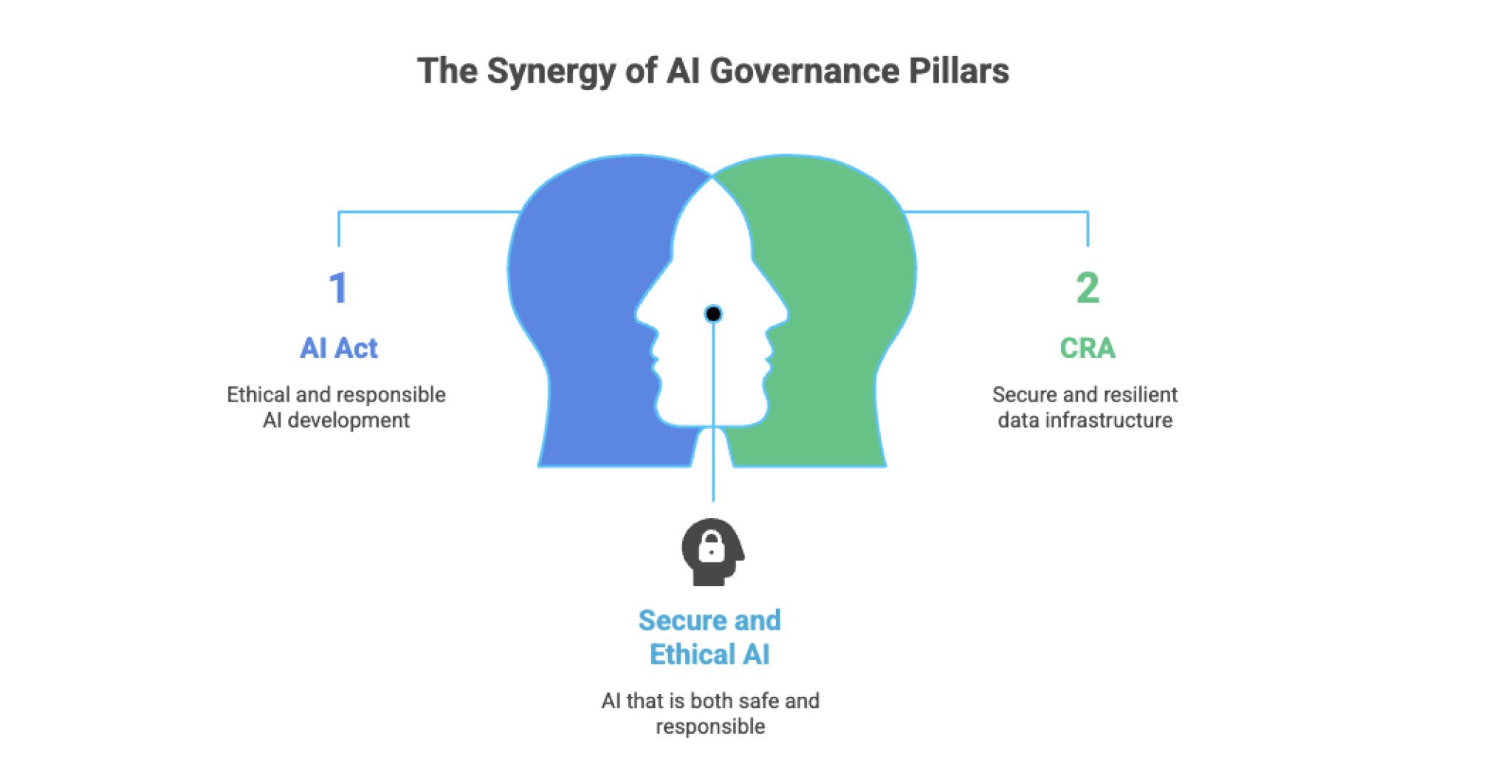
However, European companies can no longer afford to take governance lightly. With the full implementation of the EU AI Act, the Cyber Resilience Act (CRA), and the Data Act, the cost of “messy data” has shifted from a performance tax to a legal liability. Additionally, the EU AI Act entered into force in 2024, and August 2026 is the critical deadline for most “High-Risk” AI systems and General Purpose AI (GPAI) transparency rules.
The EU AI Act (The Quality & Ethics Mandate)
For “High-Risk” AI systems, Article 10 of the Act requires data provenance, bias mitigation, and traceability. Furthermore, by 2026, documentation trail is mandatory, and AI-generated content should be marked and labelled. If an auditor knocks, you should be able to trace a decision back to exact training data and bias-mitigation steps taken in the past.
The Cyber Resilience Act (CRA)
Meanwhile, the CRA governs the vessel, and by 2027, any digital product in the EU must bear the CE mark, proving it meets strict cybersecurity standards. Moreover, manufacturers of digital products must actively report exploited vulnerabilities to ENISA within 24 hours. Companies should have a Software Bill of Materials (SBOM) – a live governing inventory of every open source software component in their stack.
The Data Act (The End of Data Silos)
However, the Data Act grants users (both B2B and B2C) the right to access and share data generated by their use of connected products. Additionally, companies can no longer treat “usage data” as their exclusive asset. Your 2026 data strategy must include Data-Sharing-by-Design, and you must build APIs that allow your customers to pull their data out and hand it to a competitor – on fair and non-discriminatory terms.
The 2026 Pivot: From “Check-box” to “By Design”
Therefore, companies must now transition from a reactive data cleanup to proactive technical architecture. Governance should be embedded “By Design” in 2026. Below are the three technological shifts happening in this direction:
- From Passive Catalogs to Active Metadata – We already know high-risk AI systems must have “logging of activity to endure traceability”. This is only possible with an active metadata platform.
- Universal Semantic Layer (or “Single Version of Truth”) – Companies are adopting a universal semantic layer, which is a middleware layer that sits between your data and your AI agents.
- Zero ETL and “Secure Data Flow” – The CRA demands that digital products need to be secure throughout their lifecycle. No more brittle, hand-coded ETL pipelines.
How AI Agents Are Taking the Governance Burden
However, one of the most exciting shifts in 2026 is that we are finally using AI to solve the problems AI created. We are moving from Static BI (where you look at a chart) to Agentic BI (where an agent monitors the data and acts on it). In the old world, a Data Steward manually checked for biases or quality errors. In 2026, autonomous agents (with human oversight) operate as silent sentinels within your data stack.
Trust, Regulation, and the Human Element
Meanwhile, organizations are no longer viewing the regulations as burdens. Instead, they are using compliance to prove transparency and build trust with their customers, boards, and investors. While AI excels at speed, pattern recognition, and processing vast data, human oversight is essential to provide context, ethical reasoning, empathy, and accountability.








