
Why This Comparison Matters for AI Systems
When building AI systems, choosing between agentic RAG and classic RAG isn’t just a technical decision—it’s a strategic one. Both approaches aim to ground model outputs in external evidence, but their execution paths and tradeoffs differ dramatically. This comparison helps you decide which architecture suits your use case.
Classic RAG: The Linear Pipeline
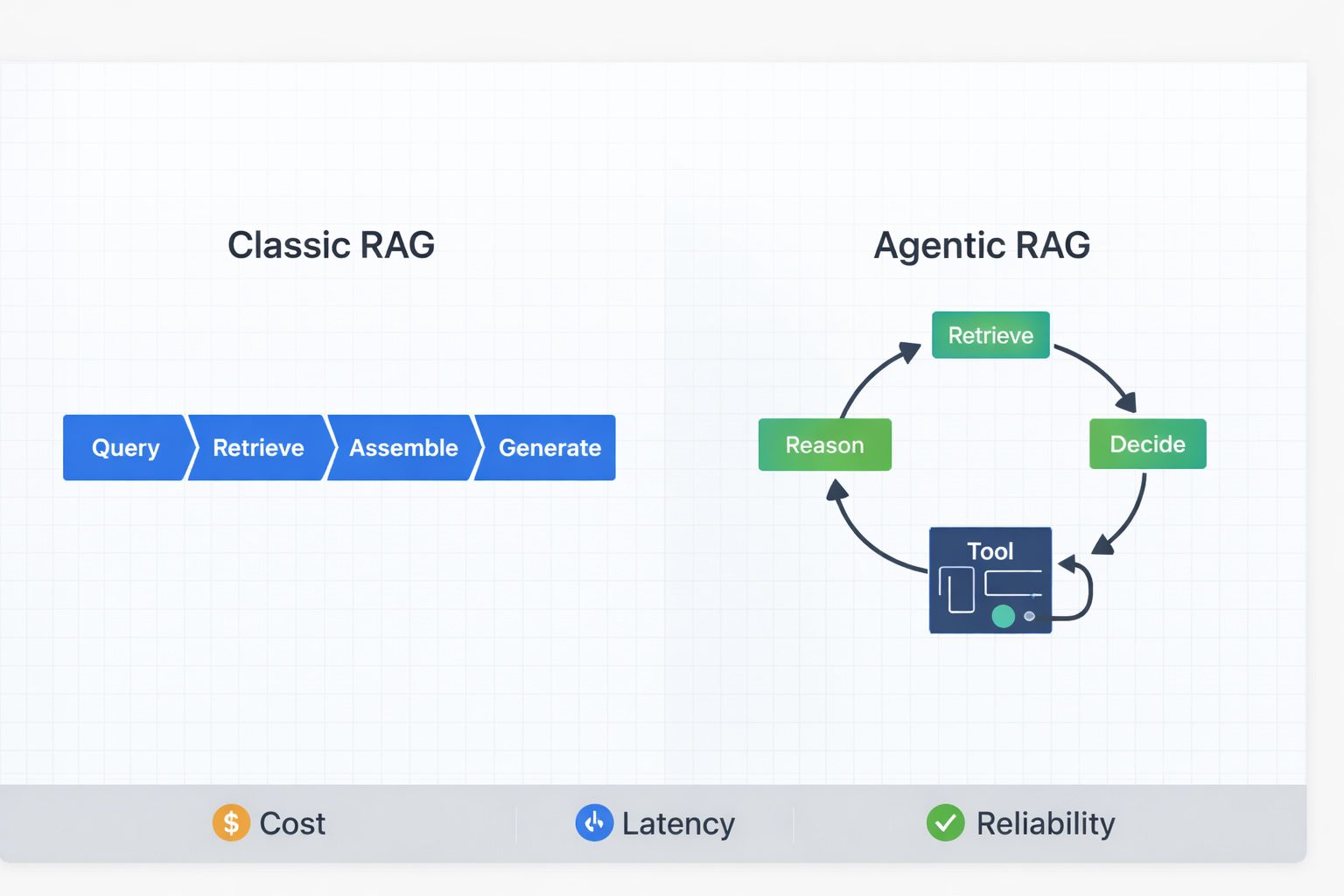
Classic RAG follows a straightforward workflow: retrieve, assemble, generate. A user query triggers a single retrieval step (often vector search), which feeds into a fixed context window for answer generation. This simplicity makes it ideal for predictable, low-latency scenarios like documentation lookups or API reference questions.
Strengths of Classic RAG
- Fast and predictable: Single-pass retrieval ensures consistent latency
- Easy debugging: Issues trace directly to retrieval relevance or chunking
- Low cost: No iterative loops or tool calls
Limitations of Classic RAG
- Brittle for multi-hop questions: Evidence spread across sources fails silently
- Struggles with ambiguity: Poorly phrased queries return weak results
- No recovery: Fails gracefully but confidently
Agentic RAG: The Control Loop Approach
Agentic RAG replaces the linear pipeline with a dynamic loop: retrieve → reason → decide. The system evaluates evidence, identifies gaps, and retries retrieval or switches tools until it meets a stop condition. This mirrors human debugging workflows—query logs, refine search terms, and escalate when stuck.
Key Advantages
- Adaptive retrieval: Refines queries or switches sources when initial results are weak
- Tool integration: Uses databases, APIs, or config checkers beyond document indexes
- Multi-hop support: Handles complex questions requiring cross-source synthesis
Tradeoffs to Consider
- Unpredictable latency: Iterative loops increase tail latency
- Higher cost: Multiple retrieval steps and tool calls
- Complex debugging: Requires monitoring control flow, not just retrieval
When to Choose Which Approach
Use classic RAG for:
- Simple lookup questions (e.g., “What does this config flag do?”)
- High-throughput, low-latency use cases
- Systems where cost predictability is critical
Opt for agentic RAG when:
- Answers require cross-source synthesis
- Queries are ambiguous or underspecified
- Robustness to retrieval failures is essential








