Introduction
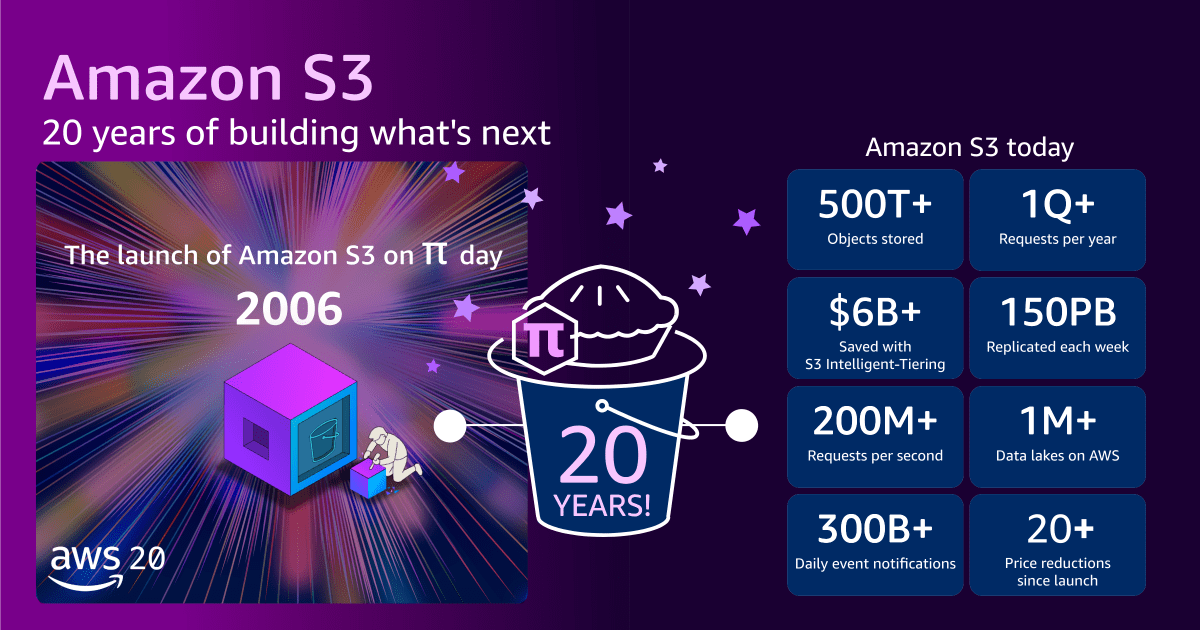
On March 14, 2006, Amazon launched a service that would quietly revolutionize the tech world. Amazon Simple Storage Service (S3) began as a simple web storage solution but has since grown into the backbone of modern cloud computing. As we celebrate its 20th anniversary, let’s explore how S3 evolved from a foundational tool to a universal data foundation—and what’s next.
The Early Days: Simplicity That Shaped an Industry
Amazon S3’s launch was understated. A one-paragraph announcement and a brief blog post introduced a service with two core functions: PUT to store data and GET to retrieve it. Yet, its true innovation lay in its philosophy: handle the “undifferentiated heavy lifting” of storage so developers could focus on creativity.
Five Unshakable Fundamentals
- Security: Data is protected by default.
- Durability: 11 nines (99.999999999%) reliability.
- Availability: Designed to handle failures seamlessly.
- Performance: Scales without degradation.
- Elasticity: Grows automatically with your needs.
S3 Today: Scale Beyond Imagination
From 1 petabyte of storage in 2006 to 500 trillion objects today, S3’s growth is staggering. It now serves 200 million requests per second across 123 Availability Zones in 39 AWS Regions. The maximum object size has expanded from 5 GB to 50 TB—a 10,000x increase. And pricing? The cost per gigabyte dropped 85% over two decades, making storage accessible for everyone.
Industry Impact
S3’s API has become a de facto standard. Vendors worldwide now build S3-compatible systems, creating a unified storage ecosystem. Even more impressive: Code written in 2006 still works today. Despite infrastructure overhauls and multiple generations of hardware, S3 maintains backward compatibility. Your 2006 data is still accessible, untouched by 20 years of innovation.
The Engineering Behind the Scale
How does S3 handle this scale? Three pillars drive its success:
1. Automated Self-Healing Systems
Microservices continuously inspect data for degradation. If a file shows signs of corruption, repair systems activate instantly. This ensures the 11 nines durability promise remains intact.
2. Formal Methods for Reliability
Engineers use mathematical proofs to verify code correctness. Every change to S3’s index subsystem undergoes automated verification, ensuring consistency and security across regions.
3. Rust for Performance
Performance-critical components are rewritten in Rust. This eliminates memory bugs and improves speed. The result? A system where scale benefits all users—larger workloads mean more de-correlated tasks, boosting reliability for everyone.
Looking Forward: S3 as the Universal Data Foundation
S3’s future is about breaking down silos. The goal: Store data once and use it everywhere. Recent innovations include:
- S3 Tables: Managed Apache Iceberg tables for optimized analytics.
- S3 Vectors: Native vector storage for AI/ML with sub-100ms latency.
- S3 Metadata: Instant data discovery for large lakes.
These tools eliminate the need for data duplication, cutting costs and complexity. In just five months, S3 Vectors processed 1 billion queries and 40 billion vectors—proof of its transformative potential.
Conclusion
Amazon S3’s 20-year journey is a testament to simplicity, reliability, and vision. From a basic storage API to a universal data foundation, it continues to redefine what’s possible. As AWS pushes boundaries with AI-ready storage and unified data platforms, one thing remains clear: S3 isn’t just storing data—it’s building the future.
Ready to explore S3’s potential for your projects? Dive into AWS’s developer resources or join the S3 community to stay ahead of the curve.