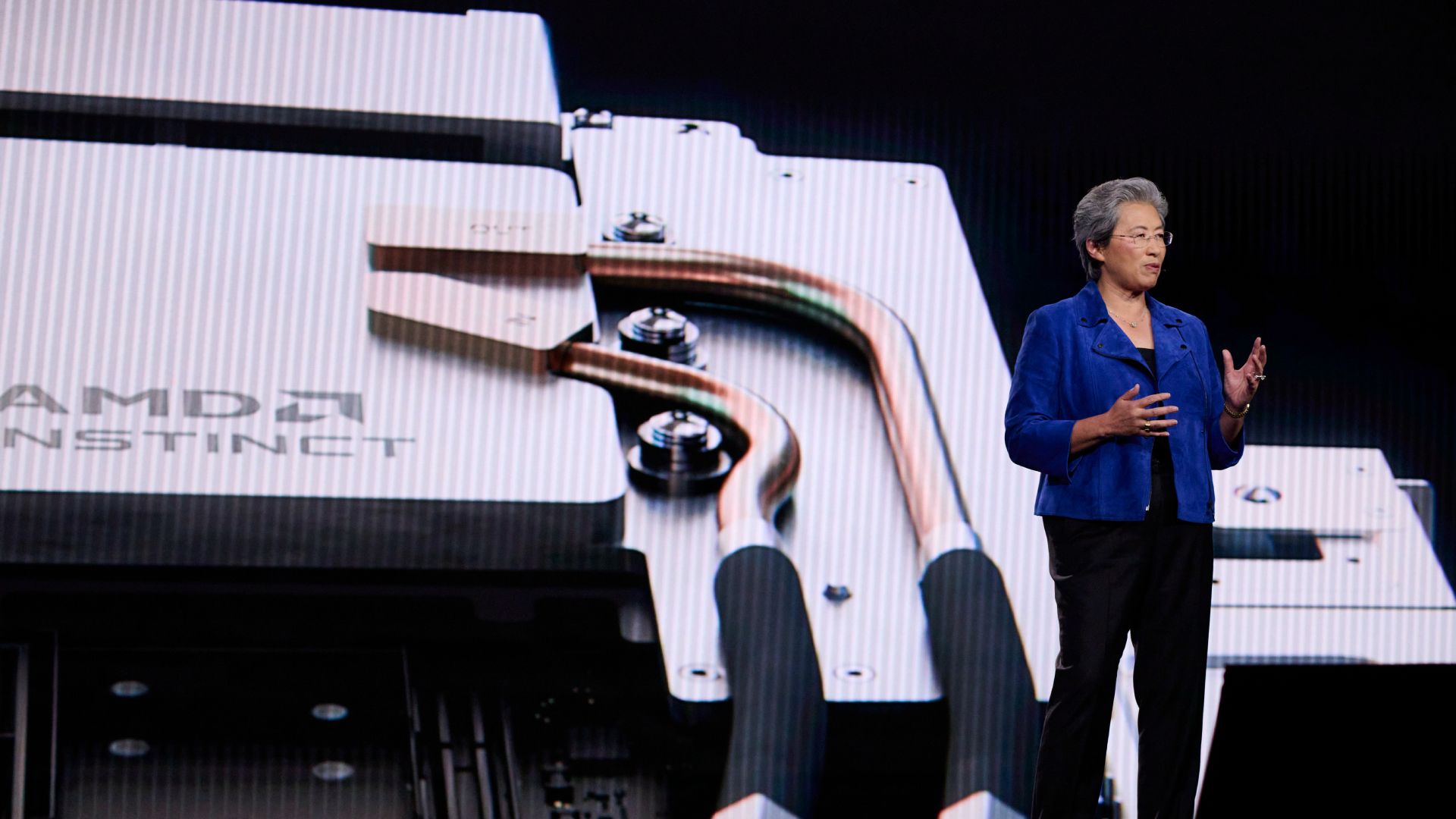
AMD Instinct MI355X: How Fewer Compute Units Boost AI Performance
AMD’s latest AI GPU, the Instinct MI355X, defies conventional wisdom by achieving double the per-compute unit (CU) throughput compared to its predecessor, the MI300X, despite having fewer CUs. This breakthrough, unveiled at the ISSCC 2026 symposium, highlights AMD’s innovative engineering strategies to maximize performance without increasing die size or power consumption.
Redesigning for Efficiency: The Core of MI355X’s Power
At the heart of the MI355X’s performance leap is a reimagined matrix execution architecture. Each Accelerator Complex Die (XCD) now features 32 active CUs—down from 38 in the MI300X—but each CU delivers 8,192 FLOPS per clock (double the MI300X’s 4,096 FLOPS). This was achieved by optimizing the matrix math hardware rather than simply scaling up the number of CUs.
Key Innovations Driving Performance
- Selective Sharing Strategy: AMD analyzed arithmetic components individually, sharing hardware only where power penalties were acceptable. This reduced die area usage while maintaining flexibility across numeric formats.
- Advanced Metal Routing: The shift from TSMC’s N5 to N3P process added two metal layers, improving routing density and addressing back-end-of-line challenges.
- Custom Clock Gating: Activity-based clock gating cells minimize unnecessary toggling, cutting switching capacitance by over 30% compared to the MI300X.
I/O Die Consolidation and Power Efficiency
AMD reduced the MI355X’s I/O die count from four to two, enabling direct die-to-die connections. This consolidation eliminated domain-crossing circuitry, freeing up space to widen the Infinity Fabric data pipeline. The result? A 1.5x increase in HBM bandwidth (5.3 TB/s to 8.0 TB/s) and a 1.3x improvement in HBM read efficiency per watt.
Power-Saving Techniques
- Custom Wire Engineering: Optimized routing patterns and segment lengths reduced interconnect power by ~20%.
- Lower Operating Voltages: The redesigned fabric runs at less power-hungry voltages while maintaining peak performance.
Local Data Share (LDS) Enhancements
The MI355X’s Local Data Share (LDS) has doubled in size to 160KB per CU (from 64KB) and bandwidth. This on-chip memory reduces reliance on slower external memory tiers during matrix operations, improving data reuse and lowering latency.
Real-World Performance Gains
AMD’s MI355X outperforms the MI325X by 2.7x in MLPerf Inference v5.1’s Llama 2 70B benchmark. Despite having fewer CUs, the GPU matches the performance of the more complex and expensive GB200, proving that efficiency trumps raw scale in modern AI workloads.
Why This Matters for AI Developers
The MI355X’s design prioritizes scalability and simplicity for AI kernels. A power-of-two CU count (32 vs. 38) simplifies workload partitioning and reduces performance bottlenecks. Meanwhile, the LDS and fabric optimizations ensure developers can maximize throughput without compromising on energy efficiency.
Conclusion: A New Benchmark for AI Accelerators
AMD’s Instinct MI355X sets a new standard for AI GPU performance by focusing on architectural innovation over brute-force scaling. With 5 petaflops of FP8 compute in the same die area as the MI300X, it’s a testament to how smart engineering can outperform traditional metrics. For developers and enterprises, this means faster, more efficient AI training and inference—without the need for overprovisioned hardware.
FAQs
How does the MI355X achieve higher performance with fewer compute units?
AMD redesigned the matrix execution hardware to double per-CU throughput while optimizing power efficiency through selective sharing and advanced routing techniques.
What are the key benefits of the MI355X’s I/O die redesign?
Reducing I/O dies from four to two eliminated domain-crossing overhead, improved HBM bandwidth, and lowered power consumption.
How does the Local Data Share (LDS) improve AI workloads?
The LDS’s increased size and bandwidth reduce memory latency, allowing the GPU to reuse data more efficiently during matrix operations.
What performance gains has AMD demonstrated with the MI355X?
The MI355X delivers a 2.7x improvement over the MI325X in MLPerf Inference benchmarks.
Why is a power-of-two compute unit count important for AI workloads?
It simplifies workload partitioning and tensor tiling, minimizing performance penalties from uneven resource allocation.