Introducing REA: Accelerating Meta’s Ads Ranking Innovation
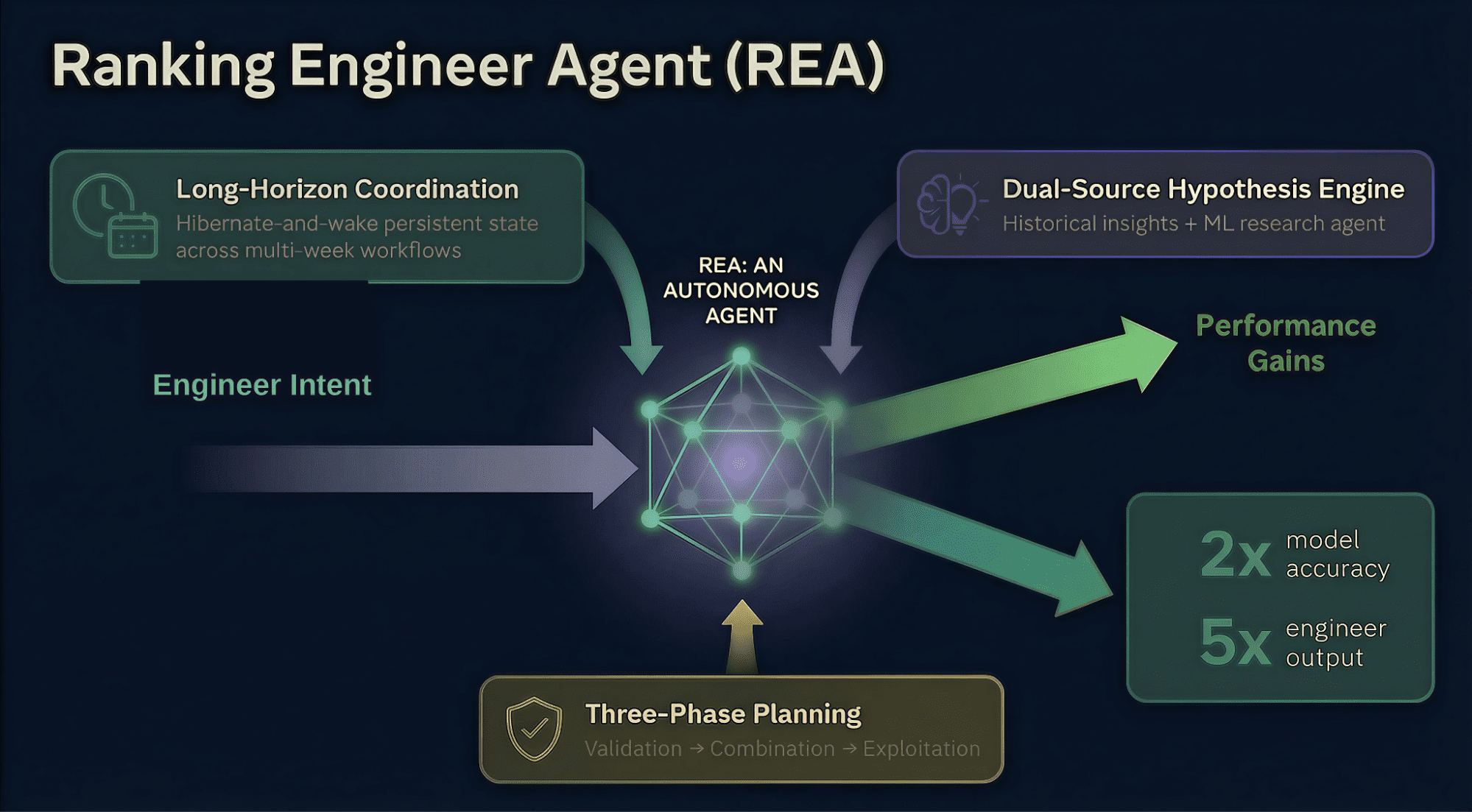
Meta’s Ranking Engineer Agent (REA) is an autonomous AI agent designed to drive the end-to-end machine learning (ML) lifecycle for ads ranking models. REA reduces the need for manual intervention, managing asynchronous workflows and delivering significant improvements in model accuracy and engineering output.
Autonomous ML Experimentation Capabilities
REA autonomously generates hypotheses, launches training jobs, debugs failures, and iterates on results. This post covers REA’s ML experimentation capabilities, with future posts exploring additional features.
The Bottleneck in Traditional ML Experimentation
Optimizing ML models has traditionally been time-consuming, with engineers crafting hypotheses, designing experiments, and analyzing results. The manual, sequential nature of traditional ML experimentation has become a bottleneck to innovation.
However, REA addresses this challenge by driving the end-to-end ML lifecycle, coordinating and advancing ML experiments across multiday workflows with minimal human intervention. For example, REA’s autonomous hypothesis generation capability has led to significant improvements in model accuracy, with a 2x increase in average model accuracy across six models.
Key Challenges in Autonomous ML Experimentation
REA addresses three core challenges: long-horizon, asynchronous workflow autonomy; high-quality, diverse hypothesis generation; and resilient operation within real-world constraints.
Long-Horizon Workflow Autonomy
REA maintains persistent state and memory across multiround workflows spanning days or weeks, staying coordinated without continuous human supervision. Meanwhile, its hibernate-and-wake mechanism enables efficient, continuous operation across extended time frames.
High-Quality, Diverse Hypothesis Generation
REA synthesizes outcomes from historical experiments and frontier ML research to surface configurations unlikely to emerge from any single approach. Additionally, its dual-source hypothesis engine combines a historical insights database with a deep ML research agent, improving with every iteration.
Resilient Operation Within Real-World Constraints
REA adapts within predefined guardrails, keeping workflows moving without escalating routine failures to humans. Furthermore, its three-phase planning framework operates within engineer-approved compute budgets, ensuring resilient execution and minimizing downtime.
Finally, REA’s autonomous ML experimentation capabilities have significant implications for the future of ML innovation. By accelerating the ML lifecycle and improving model accuracy, REA can help drive business growth and improve user experiences.
Conclusion and Future Directions
In conclusion, REA is a powerful tool for autonomous ML experimentation, driving innovation and improvement in Meta’s ads ranking models. As REA continues to evolve, we expect to see significant advancements in ML capabilities and applications. Therefore, we encourage engineers and researchers to explore REA’s capabilities and contribute to its development.
To learn more about REA and its applications, please visit our website or contact us directly. We look forward to collaborating with you and driving the future of ML innovation.