Bayesian Teaching for LLMs: Google’s New Training Method
Large language models (LLMs) excel at many tasks, but they often struggle with a critical challenge: updating beliefs as new information arrives. Google researchers have proposed a novel solution—Bayesian teaching—to train LLMs to approximate Bayesian reasoning, improving their ability to adapt in multi-step interactions. This method could revolutionize applications like recommendation systems, chatbots, and long-running AI agents.
The Problem with Current LLMs
Most LLMs fail to revise their internal assumptions effectively after new information arrives. For example, a recommendation system might suggest a flight based on initial user input but struggle to refine its choices as the user provides feedback. This limitation stems from how models are trained—typically on static datasets rather than dynamic, evolving interactions.
Why Bayesian Reasoning Matters
Bayesian inference provides a mathematical framework for updating probabilities as evidence accumulates. In real-world scenarios, this means a model should adjust its confidence in user preferences after each interaction. Without this capability, LLMs risk making suboptimal decisions in sequential tasks.
How Bayesian Teaching Works
Google’s approach trains LLMs to mimic the behavior of an optimal Bayesian system. Instead of learning only from correct answers, models are fine-tuned using predictions from a simulated Bayesian assistant. This method teaches LLMs to balance uncertainty and make probabilistic decisions during multi-step interactions.
Key Components of the Method
- Simulated Interactions: A Bayesian assistant generates training data by interacting with simulated users.
- Probabilistic Feedback: The assistant makes imperfect but informed recommendations, reflecting real-world uncertainty.
- Model Distillation: LLMs learn to approximate the Bayesian assistant’s decision-making process.
Experiment: Flight Recommendation Task
Researchers tested their method using a simulated flight recommendation task. In each round, a model and user were shown three flights defined by departure time, duration, stops, and price. The user had hidden preferences, and the model had to infer them through feedback.
Results
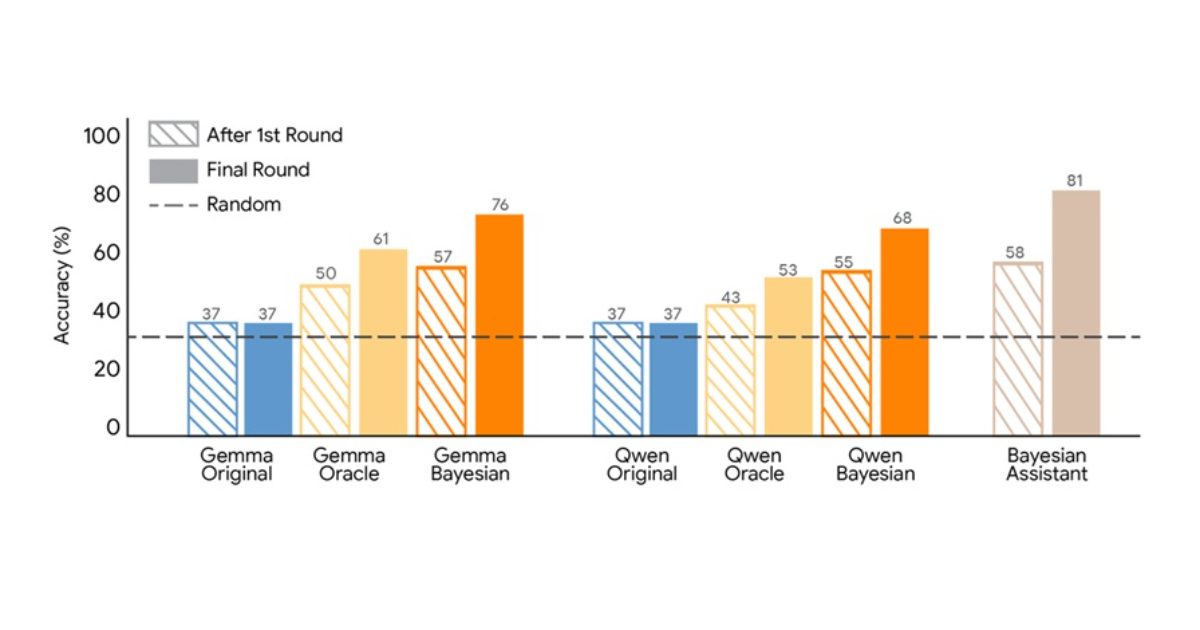
- The Bayesian assistant achieved 81% accuracy in selecting the correct flight.
- Untuned LLMs showed limited improvement after the first interaction.
- Models trained with Bayesian teaching matched the assistant’s accuracy and improved over time.
Community Reactions and Open Questions
Experts praised the method for addressing belief updates in LLMs. Software developer Yann Kronberg noted, “This could matter a lot for long-running agents.” However, some questioned why the team used supervised fine-tuning instead of reinforcement learning (RL).
Why Not Reinforcement Learning?
Researcher Aidan Li asked, “Why did the authors use SFT instead of RL?” While RL could theoretically model probabilistic inference, the team chose supervised fine-tuning for its simplicity and compatibility with existing training pipelines.
Implications for the Future
Bayesian teaching demonstrates that LLMs can acquire probabilistic reasoning skills through post-training. This approach could enhance AI systems in healthcare, finance, and customer service, where sequential decision-making is critical. As Google’s research shows, the future of LLMs lies in their ability to adapt dynamically to evolving information.
Ready to explore Bayesian methods for your AI projects? Dive deeper into Google’s research or experiment with training techniques that prioritize sequential reasoning.