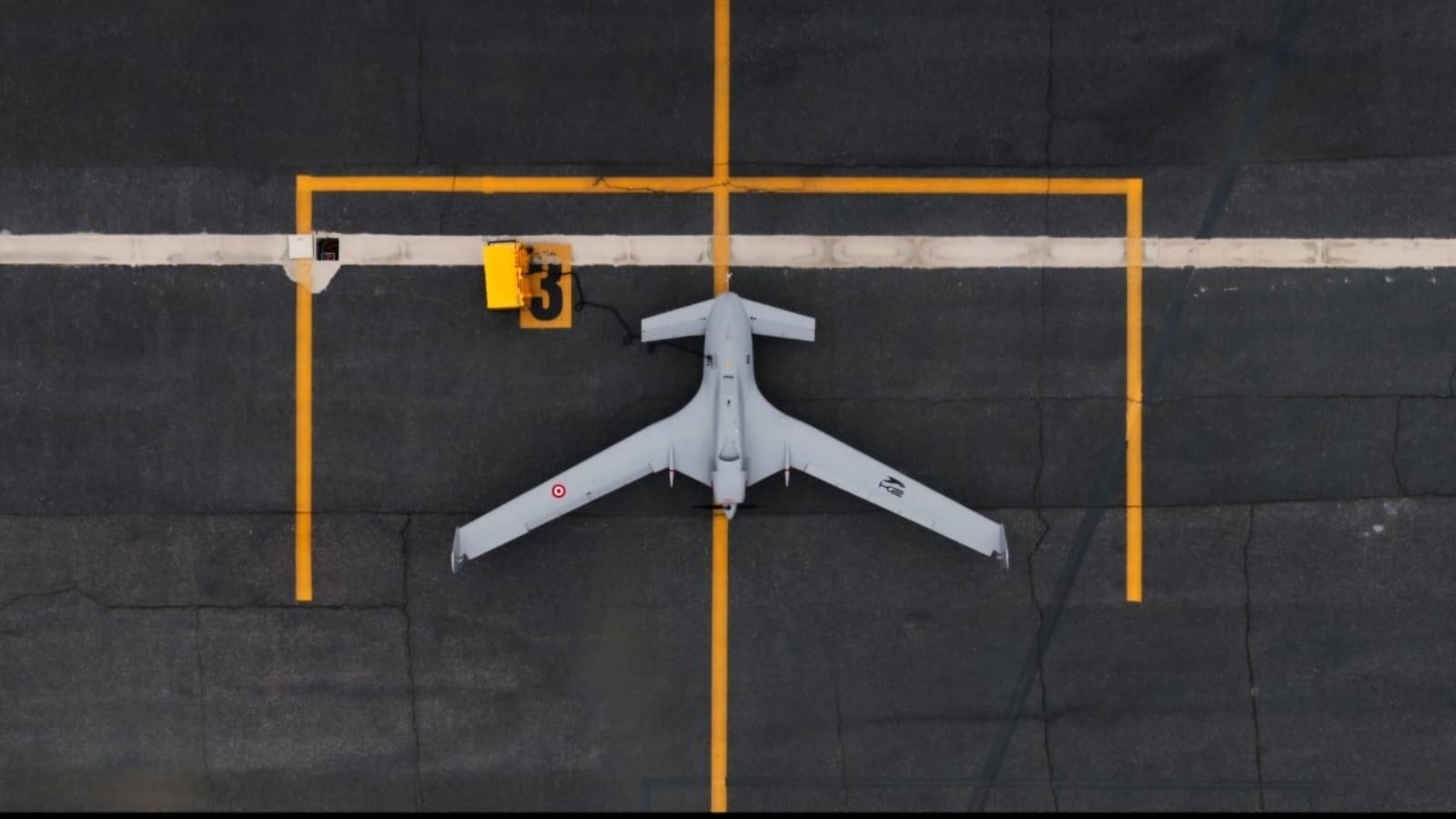
Baykar Unveils K2 Long-Range Kamikaze Drone with AI-Driven Swarm Capability
Baykar, a Turkish manufacturer, has unveiled its K2 long-range kamikaze unmanned aerial vehicle (UAV), adding a dedicated loitering munition to its expanding product line-up. The K2 was revealed through a promotional video following multi-sortie test flights conducted over the Saros Gulf.
K2 Key Specifications and Design
The K2 has a maximum take-off weight (MTOW) of approximately 800 kg and carries a 200 kg warhead. Its range exceeds 2,000 km, with an endurance of more than 13 hours and a speed surpassing 200 km/h. The platform’s aerodynamic layout is derived from the Bayraktar TB2’s fuselage but differs considerably in configuration.
AI-Driven Navigation and Targeting
A central feature of the K2 is its artificial intelligence (AI)-based navigation, targeting, and engagement system. The drone uses an electro-optical/infrared (EO/IR) gimbal camera and a night-vision-capable sensor to visually scan terrain and estimate its position, enabling autonomous flight in GPS-denied environments.
For example, during the Saros Gulf trials, one unit appeared to serve as a ‘pack leader’ for swarm coordination, while the remaining four maintained their formation positions using AI, sensors, and onboard software. Meanwhile, the K2 supports both line-of-sight and beyond-line-of-sight satellite data links, and its visual lock-on targeting allows it to engage targets using coordinate-based precision strikes even without satellite navigation.
Strike Profile and Reusability
In its current form, the K2 is a kamikaze platform – it delivers its 200 kg warhead through terminal impact on the target rather than releasing a separable munition. However, the K2 is not strictly a single-use system. It incorporates landing gear and a reusable airframe, enabling it to return to base if a mission is aborted or if the sortie is limited to surveillance without requiring a strike.
Additionally, Baykar plans to develop versions of the K2 capable of returning to base after delivering their munitions. This implies a future iteration with a separable or droppable warhead, which would shift the K2 from a loitering munition into something closer to a reusable strike UAV.
Finally, the K2 could strengthen Turkey’s position in the global combat and ISR drone market by filling a gap that the TB2, Akıncı, TB3, and Kızılelma do not currently address: a low-cost, expendable yet reusable long-range strike platform designed for contested, EW-dense environments.
Conclusion and Future Prospects
In conclusion, the K2 is a significant development in the field of unmanned aerial vehicles, offering a unique combination of range, endurance, and AI-driven capabilities. As Baykar continues to iterate and refine the K2, it is likely to become an attractive option for militaries and defense agencies around the world. Therefore, we can expect to see the K2 playing a major role in shaping the future of drone warfare and beyond.
Meanwhile, the potential for the K2 to be deployed from naval platforms, such as the TCG Anadolu LHD, adds a new dimension to its capabilities. However, further development and testing are needed to fully realize the K2’s potential. Nevertheless, the K2 is an exciting development that is sure to generate significant interest in the defense community.