
Introduction to the CLAIR Model
Modern society relies on a complex web of interconnected systems—from power grids to data centers. Yet, traditional frameworks like the Purdue Model and Zachman Framework often fail to capture the full scope of these interdependencies. Enter the CLAIR Model: a groundbreaking conceptual framework designed to bridge this gap. By synthesizing vertical depth with multi-dimensional analysis, CLAIR offers a structured approach to identifying and visualizing critical infrastructure linkages.
What is the CLAIR Model?
The Comprehensive Linkage and Architectural Infrastructure Resiliency (CLAIR) Model expands the traditional five-level Purdue hierarchy into a ten-level stack. This expansion addresses modern challenges like IT/OT convergence and cascading failures in systems-of-systems environments. Unlike siloed models, CLAIR maps dependencies from sub-physical utility grids to hyper-distributed cloud ecosystems.
Key Features of the CLAIR Model
- Unified Taxonomy: Combines the Purdue Model’s vertical depth with the Zachman Framework’s breadth.
- Extended Levels: Adds Levels -1 (primary infrastructure) and 6-7 (cloud/safety systems) to capture external dependencies.
- Diagnostic Focus: Prioritizes identifying interdependencies over immediate mitigations.
Why Traditional Models Fall Short
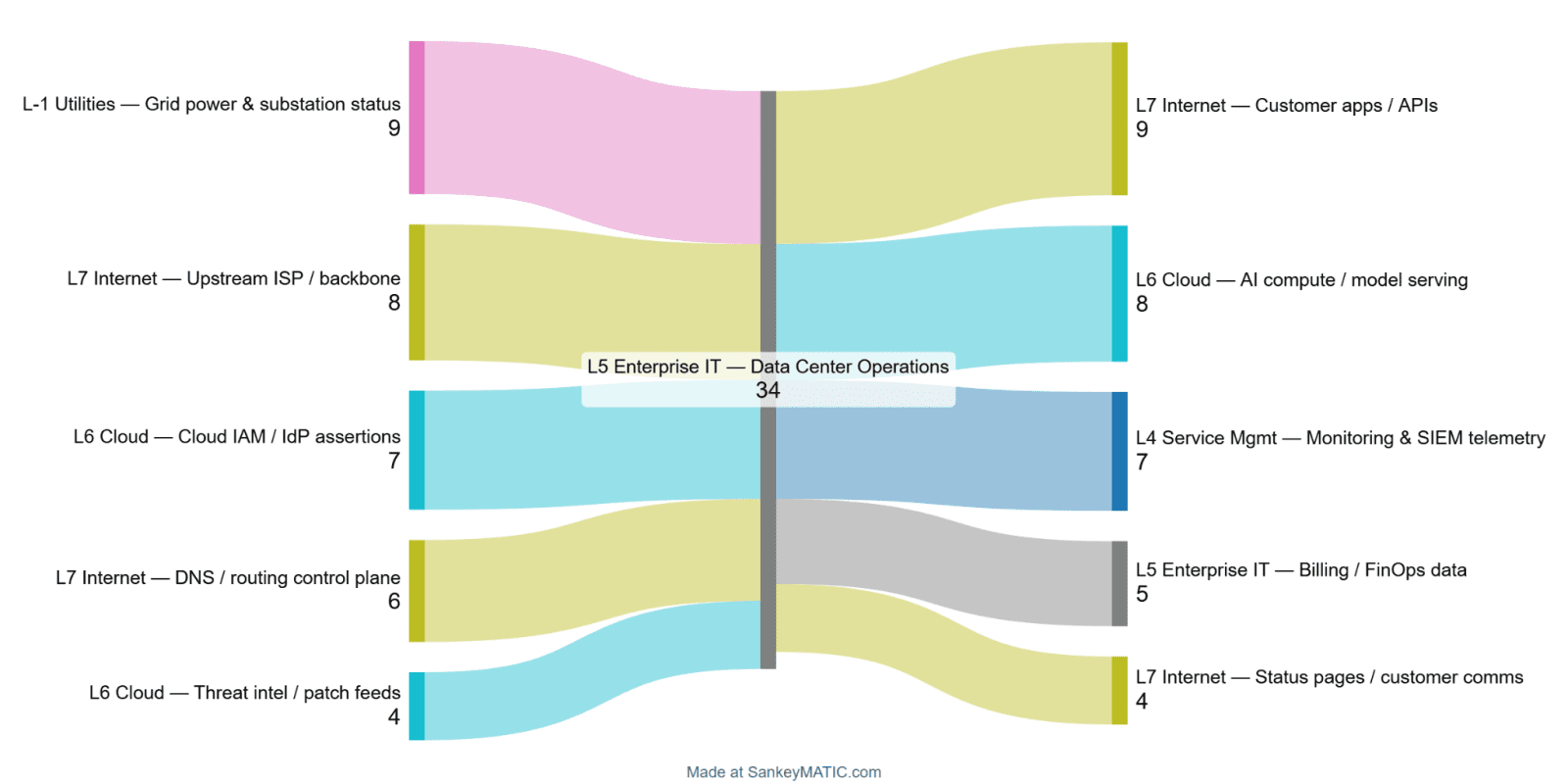
The Purdue Model, developed in the 1990s, excels at describing internal plant dependencies but treats external systems as isolated inputs. Meanwhile, EA frameworks like Zachman lack granularity for operational technology (OT) environments. This disconnect leaves critical gaps in understanding how disruptions—like power grid failures—ripple through data centers and manufacturing networks.
CLAIR’s Structural Advantages
CLAIR’s 10-level architecture explicitly accounts for:
- Level -1: Primary infrastructure (power grids, water systems).
- Levels 0-5: Controllable operational layers (sensors, controllers, business systems).
- Levels 6-7: Distributed cloud and safety-critical systems.
CLAIR Model’s 10-Level Architecture
| Level | Description | Example Assets |
|---|---|---|
| >7 | High-Trust/Safety Systems | SIS, DNSSEC |
| 6 | Cloud/Distributed Services | AWS, IIoT platforms |
| 5 | Enterprise Systems | ERP, HR portals |
| 0 | Primary Infrastructure | Power grids, pipelines |
Level -1: The Foundation of All Systems
Level -1 represents external utilities like power grids. A single fault here—such as a high-voltage line failure—can destabilize sensors (Level 0) and controllers (Level 1), triggering cascading outages. CLAIR’s inclusion of this layer ensures risks from uncontrolled infrastructure are explicitly modeled.
Practical Applications of the CLAIR Model
CLAIR enables organizations to:
- Map dependencies between data centers and regional power grids.
- Identify risks in cloud-dependent manufacturing workflows.
- Design resilient architectures for smart factories.
Conclusion and Call to Action
The CLAIR Model isn’t just a theoretical framework—it’s a practical tool for navigating today’s interconnected world. By visualizing interdependencies, organizations can preempt cascading failures and build robust infrastructure. Ready to explore how CLAIR can transform your systems? Download the full whitepaper to dive deeper into implementation strategies.








