
Context Engineering: The Key to Strategic AI Advantage
For the past three years, I’ve kept returning to a critical question: if cutting-edge foundation models are widely accessible, where could durable competitive advantage with AI actually come from? Today, I’ll zoom in on context engineering—the discipline of dynamically filling an AI model’s context window with domain-specific knowledge to maximize its effectiveness.
What Is Context Engineering?
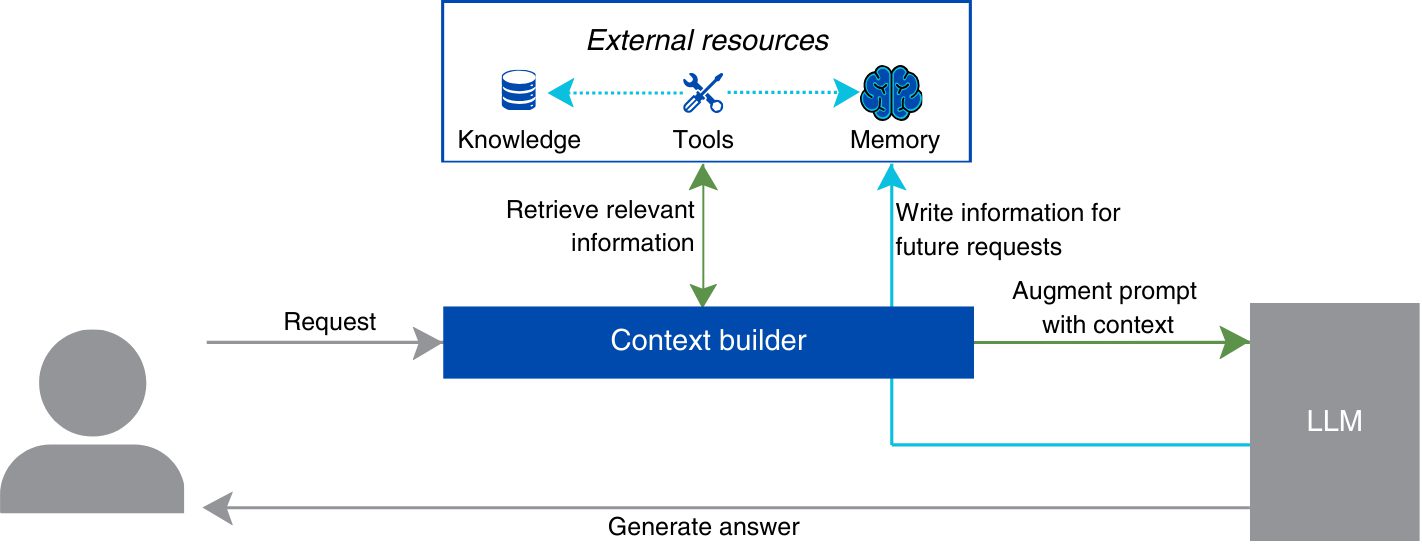
Context engineering bridges the gap between raw AI models and real-world expertise. It involves encoding domain knowledge, workflows, and tools into an AI system to turn a generic model into a specialized solution. This process requires close collaboration between domain experts and engineers. While domain experts provide the knowledge, engineers handle knowledge representation, orchestration, and dynamic context construction.
The Context Builder: AI’s Secret Weapon
At the heart of context engineering is the context builder, a component that assembles the optimal context for each user interaction. Imagine it as an intelligent function that takes a user query, retrieves relevant information from external resources, and constructs a tailored context for the AI model. After processing, the context builder can also store new insights, like user feedback, to improve future interactions.
Three Core Resources for Context Engineering
- Knowledge: Domain-specific data (e.g., historical close rates, pricing policies) transforms generic AI into a domain expert.
- Tools: Enable the AI to act in the real world (e.g., updating forecasts, accessing CRM data).
- Memory: Stores user feedback and past interactions to personalize outputs over time.
Why Knowledge Integration Matters
Consider an AI system supporting RevOps tasks like weekly forecasts. Without domain-specific knowledge, users must manually correct outputs—explaining seasonal trends, discounting patterns, or pipeline stage definitions. This friction undermines adoption. To avoid this, integrate knowledge through structured methods like Retrieval-Augmented Generation (RAG).
RAG: A Starting Point
RAG breaks domain knowledge into chunks, converts them into numerical embeddings, and retrieves relevant fragments for each query. While effective in theory, naive RAG struggles with outdated documents, inconsistent policies, and ambiguous relevance. For trustworthy outputs, move beyond isolated text fragments to structured knowledge representations.
Structured Knowledge: Graphs Over Text
Graphs offer a scalable solution by modeling business objects (deals, segments) and their relationships. Consider these approaches:
- Taxonomies: Define core business entities and their properties.
- Knowledge Graphs: Capture complex dependencies between metrics and workflows.
- Context Graphs: Track historical decisions to inform future actions.
Tools and Memory: Closing the Loop
Forecasting is both analytical and operational. Your RevOps team might need to adjust forecasts based on real-time sales data or user feedback. Tools allow the AI to act (e.g., update CRM records), while memory ensures continuity by learning from past interactions. Together, they create a system that evolves with user needs.
Conclusion: Build, Don’t Just Deploy
Context engineering isn’t a one-time task—it’s a continuous collaboration between humans and AI. By structuring knowledge, integrating tools, and leveraging memory, you create systems that adapt to your business’s unique needs. Ready to turn your AI from a novelty into a strategic asset? Start with context engineering.
FAQs
What is context engineering and how does it benefit AI systems?
Context engineering dynamically integrates domain knowledge into AI models, enabling them to perform specialized tasks with accuracy and adaptability.
Why is structured knowledge better than raw text for AI?
Structured knowledge (e.g., graphs) ensures consistency, clarity, and retrievability, while raw text often contains outdated or conflicting information.
How do tools and memory enhance AI performance?
Tools allow AI to act in the real world, while memory personalizes outputs by learning from user interactions and feedback.
Can RAG alone solve knowledge integration challenges?
RAG is a starting point but struggles with relevance and consistency. Structured representations like graphs provide more reliable context.
What’s the first step in implementing context engineering?
Begin by mapping your domain’s core objects, workflows, and KPIs to create a structured knowledge foundation for your AI system.








