Introduction to Decision Trees
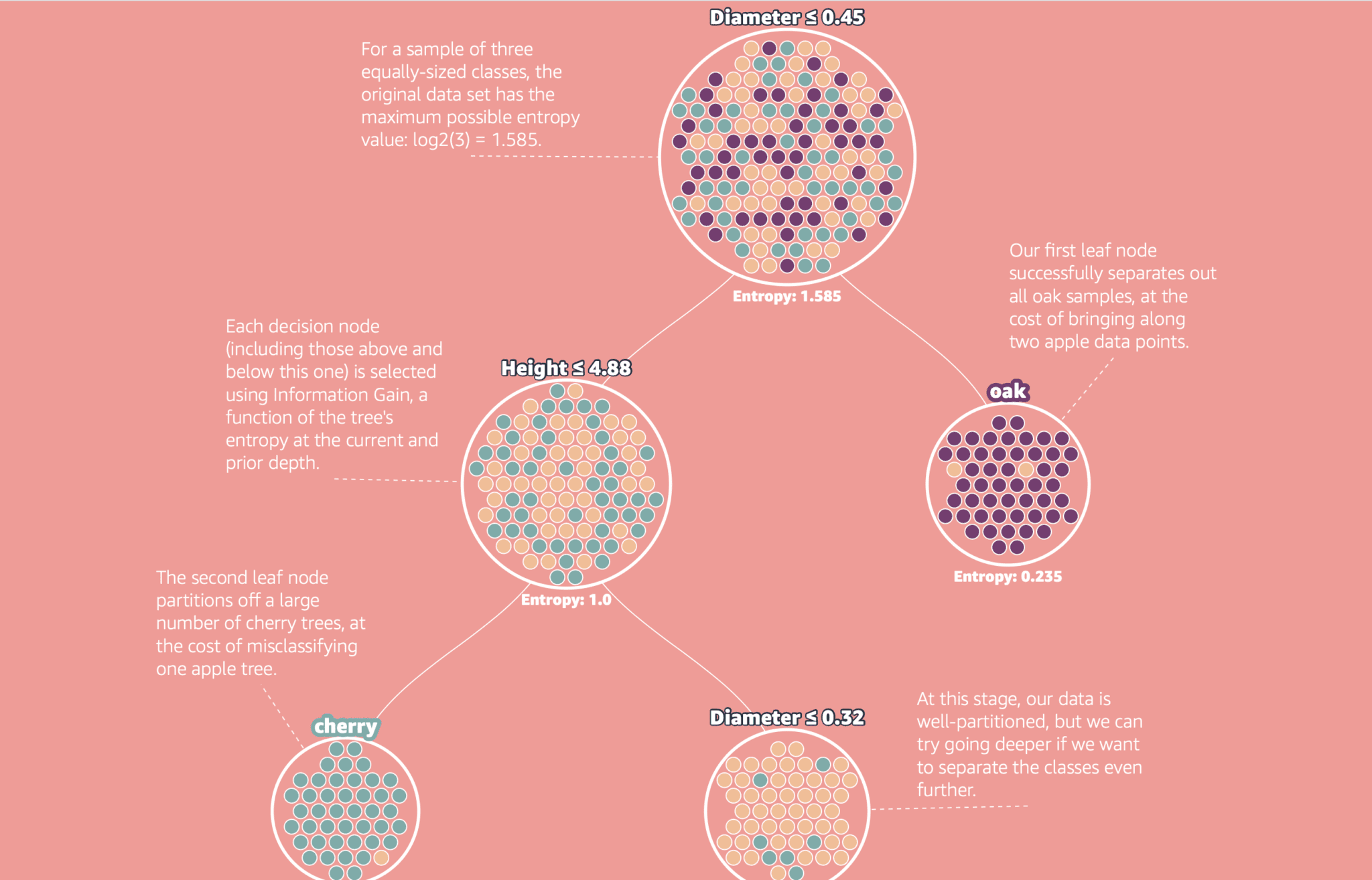
Let’s pretend we’re farmers with a new plot of land, and we need to determine the type of tree based on its Diameter and Height. We’ll use a Decision Tree to classify the trees into Apple, Cherry, or Oak. Meanwhile, this process will help us understand the power of nested decision rules.
For example, if the Diameter of a tree is greater than or equal to 0.45, it’s likely an Oak tree. Therefore, we can start by splitting our data at this point. Additionally, we’ll continue to partition our remaining data to create a more accurate Decision Tree.
Building the Decision Tree
We start by splitting our data based on the Diameter. However, we also need to consider the Height of the tree. If the Height is less than or equal to 4.88, it’s likely a Cherry tree. Meanwhile, we can continue to split our data to separate the Apple trees from the Cherry trees.
Finally, after several splits, we’ve obtained an optimal set of nested decisions. However, we need to be careful not to overfit our data. If we continue to split our data, the resulting regions would become increasingly complex, and our tree would become unreasonably deep.
Conclusion
In conclusion, Decision Trees are a powerful tool for classification problems. By using a series of nested decision rules, we can create a simple and accurate model. However, we need to be careful not to overfit our data. Therefore, it’s essential to find the right balance between complexity and accuracy.
For instance, we can use Decision Trees to classify new data points based on their Height and Diameter values. Meanwhile, we can also use this technique in other areas, such as customer segmentation or risk assessment.
Frequently Asked Questions
- What is a Decision Tree, and how does it work?
- How do we determine the optimal number of splits in a Decision Tree?
- What are the advantages and disadvantages of using Decision Trees?
- Can we use Decision Trees for regression problems?
- How does the focus keyword ‘Decision Trees’ relate to the concept of nested decision rules?