
How I Built a Sub-500ms Voice Agent from Scratch
This post made it to the Hacker News front page! If you’re building an AI or voice product and want hands-on help, I offer focused consulting. Learn more.
Why Voice Agents Are Hard
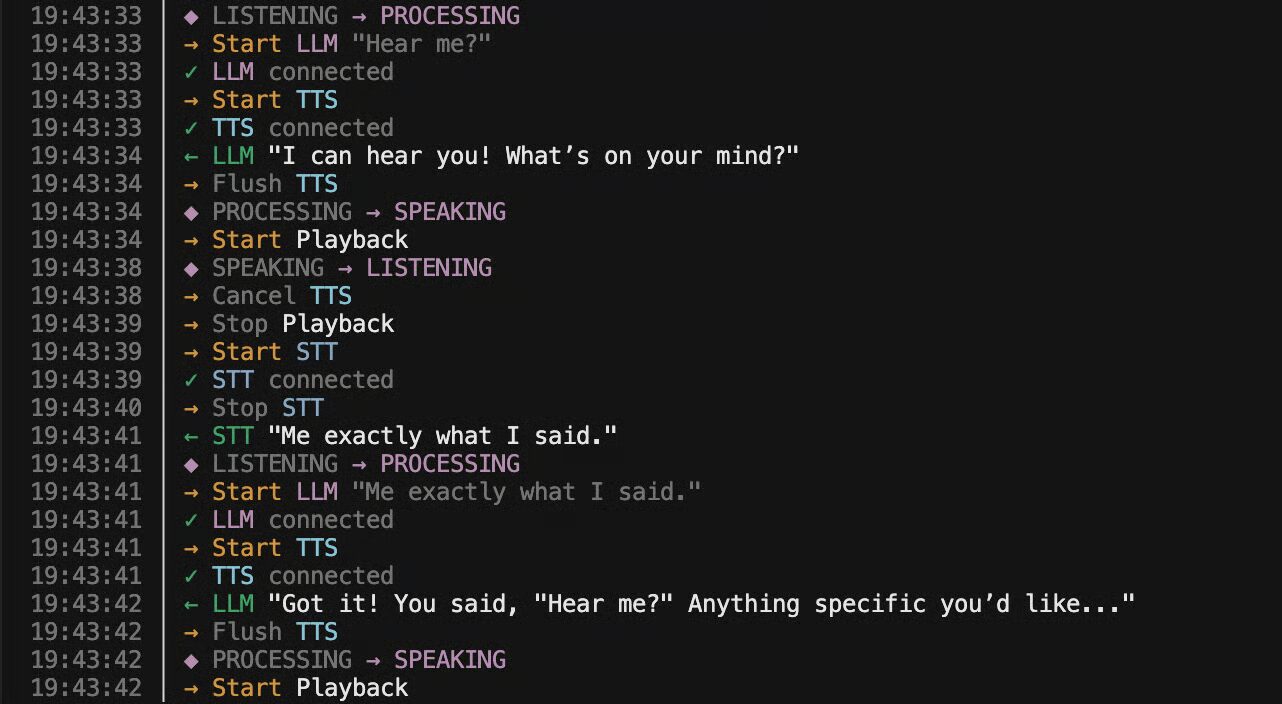
Voice agents are deceptively complex compared to text-based systems. While text agents rely on discrete user actions (typing, sending), voice systems must manage continuous real-time orchestration. The core challenge lies in turn-taking: detecting when a user stops speaking and when the agent should respond without delay.
Key challenges include:
- Distinguishing speech pauses from completed thoughts
- Handling background noise and filler sounds
- Minimizing end-to-end latency (voice agent)
The Turn-Taking Loop
I reduced the problem to a simple state machine with two states:
- User speaking
- User listening
Transitions require:
- Immediate agent silence when user speaks
- Instant response generation when user stops
First Pass: VAD and Pre-Recorded Responses
My initial prototype used Silero VAD (2MB open-source model) with a FastAPI server. Results showed promising turn detection but failed to handle natural speech pauses:
- False early turn-end detection
- No semantic context
Second Pass: Deepgram Flux Integration
Upgraded to Deepgram’s Flux API for combined transcription and turn detection. Achieved:
- 400ms end-to-end latency
- 2× faster than Vapi platforms
- Real-time audio streaming
Key Takeaways
Building a voice agent requires mastering three pillars:
- Audio processing (VAD, noise filtering)
- LLM orchestration (response timing)
- Geographic optimization (server proximity)
Want to build your own high-performance voice system? Contact me for expert guidance on:
- Latency optimization strategies
- Turn-taking architecture
- Model selection for voice pipelines
Frequently Asked Questions
How can I reduce voice agent latency below 500ms?
Focus on three areas: 1) Use lightweight VAD models like Silero, 2) Implement real-time streaming APIs, 3) Optimize server geolocation for low-latency audio routing.
What’s the biggest challenge in voice agent development?
Accurately detecting turn boundaries while handling speech pauses, background noise, and natural language flow without interrupting the conversation.
Can I build a voice agent without using all-in-one platforms?
Absolutely. By combining VAD, LLM, and TTS components with custom orchestration, you can create a system with better performance than many SDKs.
How does Deepgram Flux improve voice agent performance?
Flux combines transcription and turn detection in a single model, reducing pipeline complexity and enabling sub-500ms response times through optimized streaming.
What’s the minimum budget to build a production-grade voice agent?
Approximately $100 in API credits for initial prototyping, with cloud infrastructure costs depending on traffic volume and geographic distribution requirements.








