
How Vision Language Models Work: A 2026 Guide
Imagine teaching a language model to see. That’s the core idea behind Vision Language Models (VLMs), which combine text understanding with image analysis. In 2026, researchers no longer train these models from scratch. Instead, they build on existing text-only models, adding vision capabilities efficiently. Let’s break down how this works—and why it’s a game-changer for AI.
Why Training from Scratch Is a No-Go
Training a model to process both text and images from scratch is expensive, time-consuming, and often ineffective. Modern labs take a smarter approach: they start with a pretrained text model and add vision-specific layers. This method saves compute resources and avoids overfitting, while still achieving strong performance.
The Three Key Components
- Image Backbone: Converts raw images into numerical embeddings.
- Adapter Layer: Bridges image and text embeddings for compatibility.
- Language Layer: Generates text based on the adapted embeddings.
Image Backbone: The Vision Foundation
The image backbone is the first step in teaching a model to see. Modern VLMs use Vision Transformers (ViTs) instead of older CNNs like ResNet. ViTs split images into patches, apply self-attention, and generate a sequence of embeddings. For example, a ViT-Base model produces 197 vectors of 768 dimensions per image.
Freezing vs. Training the Backbone
Most researchers freeze the ViT weights during training. Why? Vision-language datasets are smaller than the ViT’s original training data. Freezing prevents overfitting and shifts learning to the adapter and language layers. This strategy balances efficiency and performance.
Adapter Layer: Bridging Vision and Text
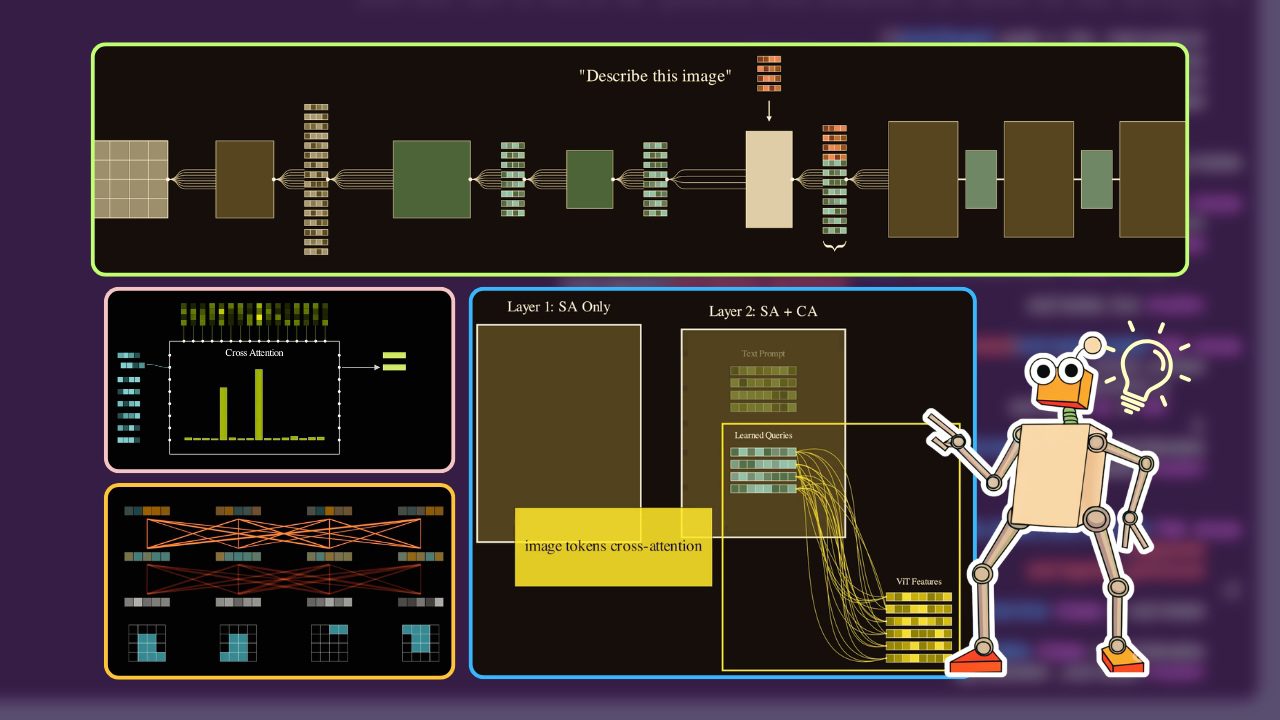
The adapter layer is where the magic happens. It transforms image embeddings into a format the text model can understand. One popular approach is the Query Former (Q-Former), introduced in the BLIP-2 paper.
How Q-Former Works
- Self-Attention: Processes text and learnable query embeddings independently.
- Cross-Attention: Connects query embeddings with ViT image embeddings.
- Joint Embedding Space: Aligns images and captions in a shared space using losses like ITC or ITM.
By alternating self-attention and cross-attention layers, the Q-Former learns to ground image features in text. This creates a compact, text-compatible representation of the image.
Language Layer: Generating Text from Vision
The final layer is a pretrained text model (like BERT) fine-tuned to accept adapted image embeddings. This model retains its language knowledge while learning to generate captions or answer questions based on visual input.
Practical Tips for Implementation
- Use frozen ViT models for efficiency.
- Train Q-Formers on paired image-text datasets (e.g., Conceptual Captions).
- Experiment with lightweight adapters like LoRA to reduce compute costs.
Why This Matters in 2026
Vision Language Models are reshaping AI applications—from medical imaging to autonomous systems. By leveraging existing text models and modular architectures, researchers can build powerful multimodal systems without starting from scratch. The key takeaway? Focus on compatibility between vision and text, not brute-force training.
Ready to dive deeper? Check out the GitHub repository for code and the YouTube video for a visual walkthrough. Start experimenting with your own VLM today!








