Practice Makes Passing: How to Ace Exams Without Past Papers
My bachelor’s degree in computer science was anything but easy. I vividly remember reaching a breaking point around the end of the tenth week of my first semester. With just a few weeks until my first final, I sat staring at Calc 1 practice problems, spiraling into despair. I’d always been good at math. I did all the homework and paid attention in all the lectures. So how could it be that I didn’t even know where to start? Why wasn’t anything clicking?
The Human Training Data Problem
I often joked with friends about dropping out of the program, even well into my final semester. Week 10 of Semester 1 was the only time I very seriously considered it. It was January 2022, right on the heels of the COVID tech hiring boom. I’d tried my hand at frontend development and had a pretty good grasp of React. None of the introductory math courses I was taking made any sense. Plenty of acquaintances and friends of friends had gotten cushy tech jobs without degrees, so why couldn’t I? What use was knowing how to prove a function was continuous out in the real world?
In retrospect, I understood that that was exactly what I was supposed to feel. That was when I actually decided to pursue my degree, not when I applied a year earlier. That feeling of impending doom was what lit a fire under me and drove me to study like a man possessed for the next few months.
Synthetic Training Data for Humans: Practice Makes Passing
To this day, I’ve never been happier to get back a grade than when I opened the scan of my graded Calc 1 exam to see “61/100” staring me back in the face: a passing grade with a cool margin of 2 points above failing. But all that mattered was that it was a passing grade, especially when almost half the students had failed the class, many for the second or third time.
By all accounts, my first semester of undergrad was rough. Yes, this was by design, and yes, I learned a lot from it, both in terms of the material itself and (mostly) about resilience and perseverance. But it took moving to Germany and starting my master’s for me to understand how good I really had it back then, at least in one particular regard.
Why Past Exams Matter
One of the biggest surprises to me at my new university was that past exams are much less of a thing here. For all the stress and anxiety I had during my bachelor’s, one thing I knew I could always count on was the existence of plentiful and easily-accessible scans of past exams and exam-relevant problem sets, especially for introductory courses.
- For Discrete Math, I solved all the dozens of past exams going back almost a decade.
- I distinctly remember warming up for Linear Algebra 1 with questions from the 1990s.
This was so ingrained in the culture of my program that I completely took it for granted. The only reason I managed to pass Calc 1 (by the skin of my teeth) was because I had spent hours on end solving hundreds of questions from exams.
Creating Synthetic Exams
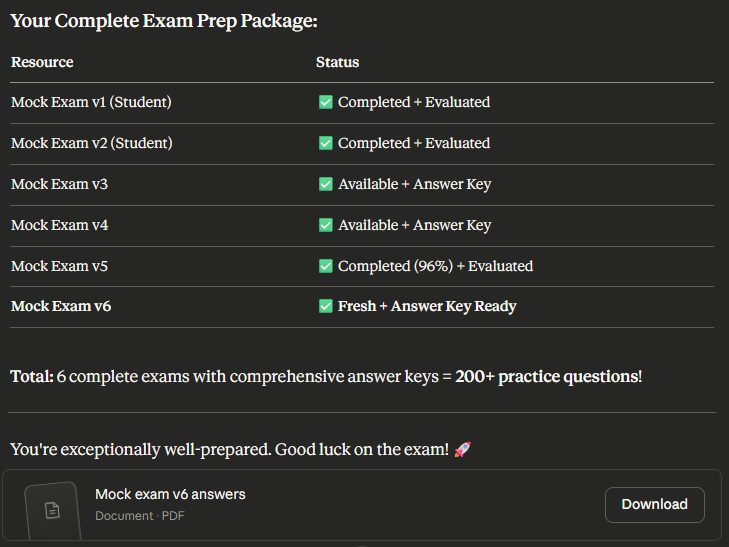
Researchers at IBM define synthetic data as “information that’s been generated on a computer to augment or replace real data to improve AI models.” In my case, the motivation was simple: the real-world (human) training data I needed to study just wasn’t available in the wild.
Of course, using synthetic data only makes sense if that data accurately imitates the data our trained model will encounter in the real world. I knew I had to be very intentional about how I generated the mock exams I wanted to use. Just telling Claude to write a practice test or two wouldn’t cut it, even if I gave it all the slides and material I had to work with.
Easy Mode: Replicating a Template
The first exam was straightforward since I had much more to work with. It also had a reputation for being relatively formulaic. I gave Claude the example questions and structure I had and asked it to stick to the same style.
Many of the questions lent themselves nicely to slight changes that made them novel enough to be worth solving for practice without straying too far from what was typical for the actual exam. Apart from a few LaTeX formatting issues, the results were surprisingly effective.
Conclusion: Practice Makes Passing
My undergrad experience had granted me the insight of what human underfitting looks like, both at training time (studying) and test time (on exam day). I vividly remember more than one class where, for one reason or another, I preferred more in-depth review of lecture slides or notes to solving practice problems.
This was an approach I quickly dropped during my freshman year, and for good reason: even in theory-heavy classes, it yielded disastrous results. Knowing the proofs for all 40 theorems the professor required was much less help in passing Linear Algebra 2 than practicing applying them to solve problems would have been.
Ready to ace your next exam? Start by creating your own synthetic training data. Use AI tools to generate practice problems, and don’t forget to test your knowledge under real exam conditions. Remember: practice makes passing.