Reducing our monorepo size to improve developer velocity
At Dropbox, almost every product change flows through a single place: our server monorepo. A monorepo is a single, shared Git repository that contains many services and libraries used across the company. Instead of splitting code across dozens of smaller repositories, we keep a large portion of our backend infrastructure in one place. That architecture makes cross-service development easier, but it also means the repository sits at the center of nearly everything we build.
Building AI-powered features at Dropbox
Building AI-powered features at Dropbox often requires small changes across ranking systems, retrieval pipelines, evaluation logic, and UI surfaces. All of that work moves through the same engineering loop: pull the latest code, build and test it, get it reviewed, merge it, and ship it. Over time, we began to notice that this loop was getting slower. Our monorepo had grown to 87GB; downloading a full copy of the codebase (or “cloning” the repository) took more than an hour, and many continuous integration (CI) jobs were repeatedly paying that cost. We were also approaching GitHub’s 100GB repository size limit, which introduced real operational risk.
Reducing the repository size
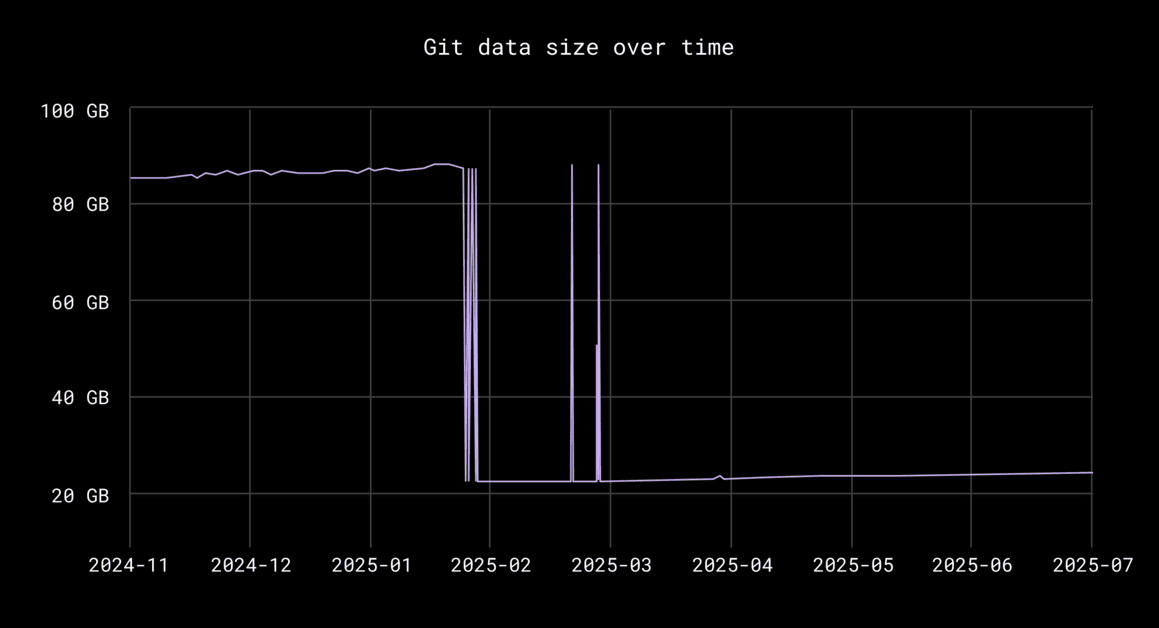
In this post, we’ll share how we reduced the repository from 87GB to 20GB (a 77% reduction), cutting the time required to clone the repository to under 15 minutes. We’ll also explain what was driving the growth and what we learned about maintaining a large monorepo at scale.
When repository size becomes a real problem
To understand why repository size matters, it helps to look at how engineers actually work. The first time someone sets up their development environment, they clone the repository, meaning they download a full copy of the codebase and its history to their machine. After that initial setup, daily work is less intensive. Engineers fetch and pull incremental updates rather than redownloading everything. But that first clone is unavoidable, and when the repository reached 87GB, it regularly took more than an hour.
When compression backfires
At first, we looked for the usual causes of repository bloat: large binaries, accidentally committed dependencies, or generated files that didn’t belong in version control. None of those explained what we were seeing. The growth pattern pointed somewhere less obvious: Git’s delta compression.
Git doesn’t store every version of every file as a complete copy. Instead, it tries to save space by storing the differences between similar files. When multiple versions of a file exist, Git keeps one full version and represents the others as deltas, or “diffs,” against it. In most repositories, this works extremely well and keeps storage efficient.
The issue was how Git decides which files are similar enough to compare. By default, it uses a heuristic based on only the last 16 characters of the file path when pairing files for delta compression. In many codebases, that’s good enough. Files with similar names often contain related content. Our internationalization (i18n) files, however, followed this structure:
i18n/metaserver/[language]/LC_MESSAGES/[filename].po
The language code appears earlier in the path, not in the final 16 characters. As a result, Git was often computing deltas between files in different languages instead of within the same language. A small update to one translation file might be compared against an unrelated file in another language. Instead of producing a compact delta, Git generated a much larger one.
Routine translation updates were therefore creating disproportionately large pack files. Nothing about the content was unusual. The problem was the interaction between our directory structure and Git’s compression heuristic. Once we understood that mismatch, the rapid growth of the repository finally made sense.
Testing a fix locally
Once we suspected that delta pairing was the root cause, we looked for ways to influence how Git grouped files during compression. We found an experimental flag called –path-walk that changes how Git selects candidates for delta comparison. Instead of relying on the last 16 characters of a path, it walks the full directory structure, which keeps related files closer together.
We ran a local repack—essentially asking Git to reorganize and recompress the objects in the repository—using this flag. The results were immediate. The repository shrank from the low-80GB range to the low-20GB range. That confirmed our hypothesis: the issue wasn’t the volume of data, but how it was being packed.
However, that success exposed a new constraint. GitHub told us that –path-walk was not compatible with certain server-side optimizations they rely on, including fe