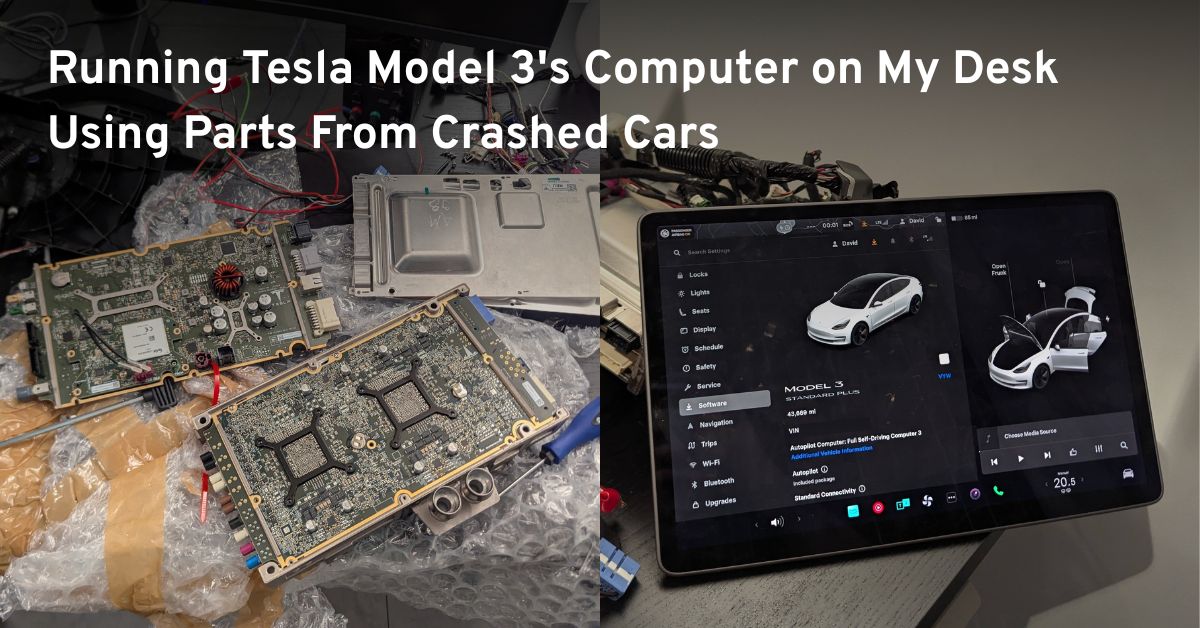
Reviving Tesla’s Computer: A Journey of Salvaging and Innovation
As a tech enthusiast, I’ve always been fascinated by the inner workings of complex systems. Recently, I embarked on an intriguing project: reviving a Tesla Model 3’s computer on my desk using parts from crashed cars. This journey not only tested my technical skills but also provided valuable insights into the world of automotive electronics.
The Bug Bounty Program and the Quest for Hardware
Tesla’s bug bounty program offers researchers a unique opportunity to find security vulnerabilities in their vehicles. To participate, I needed access to the actual hardware, which led me to search for Tesla Model 3 parts on eBay. My goal was to obtain a Tesla car computer and touchscreen, capable of booting the car’s operating system.
The Car Computer and Its Components
The car computer consists of two main parts: the MCU (Media Control Unit) and the autopilot computer (AP) layered on top of each other. The MCU is roughly the size of an iPad and the thickness of a 500-page book, covered in a water-cooled metal casing.
Salvaging the MCU and Autopilot Computer
By searching for ‘Tesla Model 3 MCU’ on eBay, I found numerous listings in the $200-$300 USD price range. Many of these sellers are ‘salvaging’ companies that buy crashed cars, disassemble them, and list individual parts for sale. I managed to acquire the MCU and autopilot computer for a reasonable price.
The Power Supply and Touchscreen Module
To power the computer, I needed a DC power supply capable of providing 12V. I opted for an adjustable 0-30V model from Amazon, which proved to be a good decision as the full setup consumed up to 8A at peak times. The touchscreen module was surprisingly expensive, but I found a good deal for $175.
The Display Cable Conundrum
The last and most challenging part to order was the cable connecting the MCU to the screen. Both the computer and screen were sold with the cables cut a few centimeters after the connector. I discovered that Tesla publishes the wiring ‘Electrical Reference’ for all its cars publicly, which helped me identify the required cable.
Overcoming Obstacles and Finding Solutions
After digging around, I found that the display uses a 6-pin cable with a special Rosenberger 99K10D-1D5A5-D connector. However, this cable was not available for purchase online. I eventually discovered that it’s similar to a widely used automotive cable called ‘LVDS,’ which is used to transfer video in BMW cars. I ordered the LVDS cable, which unfortunately didn’t fit the screen’s connector.
Improvise, Adapt, and Overcome
I attempted to strip the original ‘tail’ cables from the MCU and screen, connecting the individual wires together. However, this setup worked for only a few seconds, causing wire debris to fall on the PCB and short it, burning one of the power controller chips. I had to order a whole new car computer and eventually replaced the damaged chip with the help of a friend and a local PCB repair shop.
The Final Piece of the Puzzle
After acquiring the new car computer, I was able to connect it to the screen using the LVDS cable. I also managed to find the name/model of the burned chip, the MAX16932CATIS/V+T step-down controller, and ordered a replacement. With the help of a local PCB repair shop, we successfully replaced the chip, and I had two functional computers.
The Importance of Persistence and Collaboration
This project taught me the value of persistence, collaboration, and creative problem-solving. I learned that even when faced with seemingly insurmountable obstacles, it’s possible to find innovative solutions with the right mindset and support.
This journey not only allowed me to revive a Tesla Model 3’s computer on my desk but also provided a unique opportunity to explore the world of automotive electronics. I hope that this story will inspire others to take on similar challenges and push the boundaries of what’s possible.
As I reflect on this experience, I’m reminded of the importance of staying curious, being open to new challenges, and embracing the unknown. The world of technology is constantly evolving, and it’s up to us to stay ahead of the curve and push the boundaries of what’s possible.
Thank you for joining me on this journey. I hope that you’ve found this story informative, entertaining, and inspiring. If you have any questions or comments, please don’t hesitate to reach out.