The $1.6M Weekend: Why API Gateways Fail in the Agentic Era
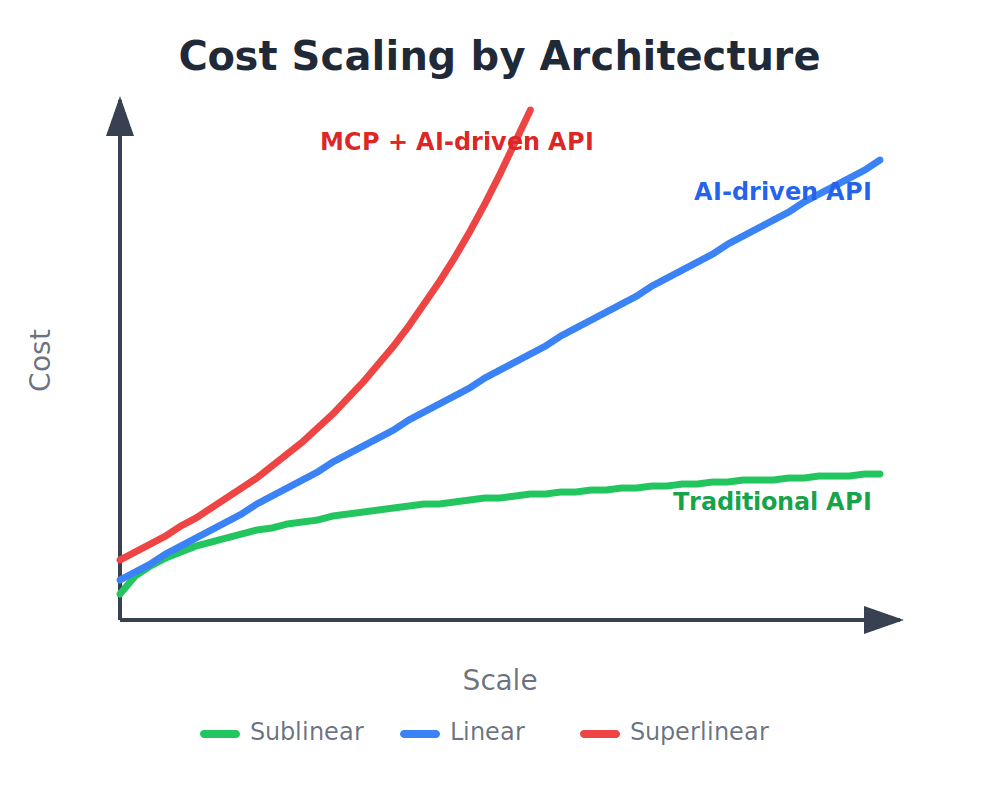
Imagine an AI-powered contract review API that costs $1.58 per document. It works flawlessly for internal apps. But when exposed to agentic consumption via MCP, a single document gets processed 1,000 times. Multiply that across a batch of 1,000 contracts, and the weekend bill hits $1.6 million. This isn’t a hypothetical—it’s a real-world example of how traditional API gateways struggle with agentic systems.
The Blind Proxy Problem in Agentic APIs
Stateless API gateways validate each request in isolation. They check tokens, rate limits, and scopes but miss patterns. For example, request #847 looks identical to #846. The gateway approves both, unaware of the 1,000 retries consuming $1.6 million in costs. This “blind proxy” issue exposes a critical flaw: stateless architecture can’t track agent behavior across sessions.
Human-consumed APIs work differently. Developers use predictable code paths and give up after a few retries. Agentic systems, however, execute non-deterministically. They hallucinate parameters, retry endlessly, and blur the line between user intent and agent autonomy. Traditional “whack-a-mole” API abuse fixes now feel like playing the game at 1,000 rounds per minute.
Three Pillars of Agentic API Governance
Governing agentic APIs requires a framework built on three pillars:
1. Economic Governance
- Session-based cost tracking: Monitor cumulative spend per Mcp-Session-Id.
- Velocity monitoring: Flag abnormal burn rates (e.g., $3.21 per minute for 127 identical requests).
- Kill switches: Automatically halt sessions exceeding hard caps.
2. Behavioral Governance
- Scope enforcement: Block actions like DELETE /users/all for agents with read: data scope.
- Scope drift detection: Track sequences like document search → HR records → database export.
- Risk scoring: Trigger human-in-the-loop approvals for suspicious patterns.
3. Identity Governance
- Client ID Metadata Documents (CIMD): Allow agents to self-register securely without human intervention.
- Machine-speed identity: Enable agents to move at LLM speed, not developer portal speed.
- Accountability: Audit logs must trace actions to both users and agents.
Session-Aware Gateways: The New Architecture
Traditional RESTful APIs prioritized statelessness for scalability. Agentic systems demand session-aware governance. A hybrid architecture is needed:
- Stateless identity: JWT validation and CIMD checks for horizontal scaling.
- Stateful governance: Track spend, counts, and behavior in a Redis/Memcached cache.
This shift isn’t just technical—it’s cultural. Gartner predicts 40% of agentic AI projects will fail by 2027 due to cost overruns and poor risk controls. The solution? Session-aware gateways that detect loops, scope drift, and escalation patterns in real time.
Conclusion: Building Resilience in the Agentic Era
The $1.6 million weekend isn’t an outlier—it’s a warning. Traditional API gateways can’t handle the chaos of agentic systems. By adopting session-aware governance, economic tracking, and identity-first design, enterprises can avoid catastrophic cost overruns. Start by auditing your current API infrastructure: Are you tracking behavior across sessions? Can you detect a retry loop before it burns $1.6 million? The future of agentic APIs depends on answers to these questions.
Takeaway: Implement session-aware governance today. Your next $1.6 million weekend might be just a few retries away.