The Context Advantage: Why Enterprises Must Own Context to Win in AI
When OpenAI announced its persistent memory feature for ChatGPT in early 2025, it was presented as a convenience. Users could now have the model remember prior context, preferences, and facts, making interactions smoother and more personal. On the surface, it was a feature update. But at a deeper level, it hinted at a shift that mirrors the most powerful transitions in the history of computing: the migration of control from execution to understanding.
The Historical Migration of Strategic Value
Every major technological era redefines where value resides. In the age of the personal computer, it was the operating system—the layer that mediated between hardware and application. In the internet era, the value migrated to the browser and the search index, mediating scarce attention. In the smartphone era, the app store became the value keeper, mediating distribution. In the cloud era, infrastructure took its turn, abstracting hardware into services and mediating computation.
Each of these shifts shared a common pattern: value flowed toward the layer that mediated the scarce resource of the age. The same pattern is now unfolding in AI. The scarce resource is not compute or data, but context, the live understanding of how facts, entities, relationships, and permissions come together in a given moment to make reasoning relevant.
The Context Fabric: The New System of Record
The power of the cloud was that it abstracted infrastructure. The power of AI is that it abstracts reasoning itself. What used to require procedural code can now be expressed probabilistically through prompts and retrieval. But abstraction always introduces a new dependency; whatever layer provides convenience becomes the new point of control.
For AI, this control lives in how context is assembled, stored and retrieved. A model without context is like a processor without memory; it can compute, but it cannot reason about the world. Every enterprise serious about AI will eventually build what might be called a context fabric. This is an architectural layer that connects systems of record (CRM, ERP, tickets, documents, telemetry, etc.) to systems of reasoning.
This fabric is a new system of record. It stores not data itself, but the relationships that give data meaning, transforming facts into usable knowledge. The fabric’s stability depends on:
- Services: The control layer handling retrieval, ranking, and policy.
- Contracts: The stable schemas, entity identifiers, and policy definitions that keep meaning consistent over time.
- Observability: Feedback, traces, and drift detection to monitor the system’s performance.
Beyond Mere Retrieval
The context fabric enables a critical feedback loop. As observability services within the fabric monitors model responses (using feedback, traces, and drift detection), they identify reasoning gaps. This rich, validated context can then be used to fix those gaps, leading to a virtuous cycle. Context leads to better reasoning, which constantly refines the fabric structure. This ensures the context fabric is a continuously self-improving cumulative asset.
The Economic Imperative: Why Context is a Moat
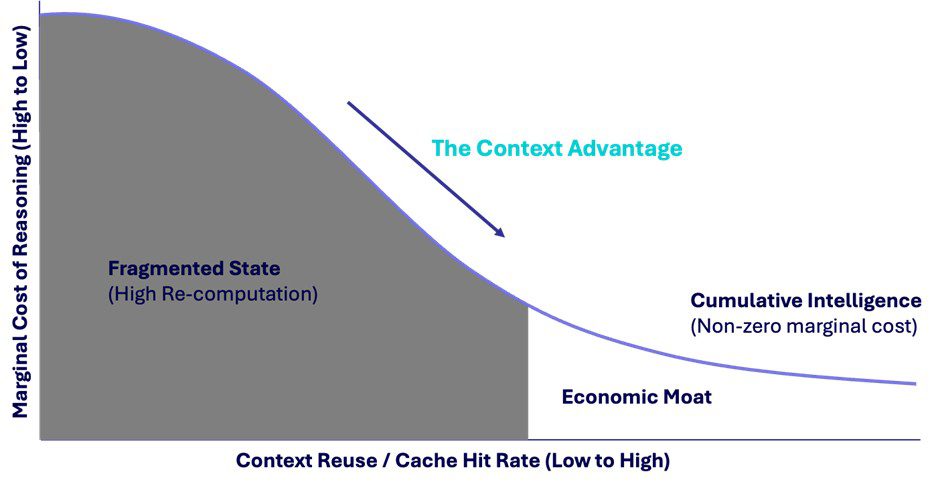
For the enterprise CIO, the shift to context isn’t just an architectural detail, but it is the primary economic lever of the AI era. Building a context fabric is an upfront investment, but it creates a persistent economic advantage—a “moat”—by fundamentally changing the cost structure of intelligence.
This shift is visualized by the context cache curve. Just as early cloud computing created data gravity, AI is creating context gravity, which is the tendency for intelligence to concentrate where the richest, cleanest, most coherent context resides.
The Maturity Journey
Most enterprises will not start with a context fabric. They will begin, as they did with cloud, in fragmentation. Teams will build isolated retrieval pipelines, creating “sprawl.” The journey to a true platform follows a predictable maturity model:
- Sprawl: Isolated experiments and fragmented retrieval logic.
- Unification: Standardization begins, requiring common identifiers and shared ontologies to achieve interoperability.
- Platformization: The context fabric is established as a true platform, serving multiple domains with retrieval and policy as shared services.
- Portability: The fabric becomes portable, capable of running across different model providers and clouds without losing meaning.
The Organizational Barrier: Fighting Conway’s Law
The most significant barrier to this journey is not technical, but organizational. Conway’s Law suggests that systems inevitably mirror the communication structures of the organizations that build them. A siloed organization will naturally produce a “sprawl” of disconnected context pipelines.
True “context gravity” requires the organization to fight this inertia. Achieving a unified fabric forces a confrontation: distinct departments must agree on shared definitions of truth. The winners of the AI era will be the organizations capable of re-wiring their human communication structures to match AI’s need for unified context.
Seizing the Context Advantage: Implications for the CIO
Context ownership is the final frontier. Cloud infrastructure made computing elastic. Context infrastructure will make intelligence cumulative.
While the infrastructure layer drives the cloud world, context is going to drive the AI world, making the shift from infrastructure to semantics. The winners will be those who know how to navigate and build the context fabric:
- The CIO must lead the charge in building a unified context fabric.
- The organization must re-wire its communication structures to match AI’s need for unified context.
- The context fabric must be built with observability, feedback, and drift detection to ensure its stability and self-improvement.