UAE Air Defense: A Complex Challenge
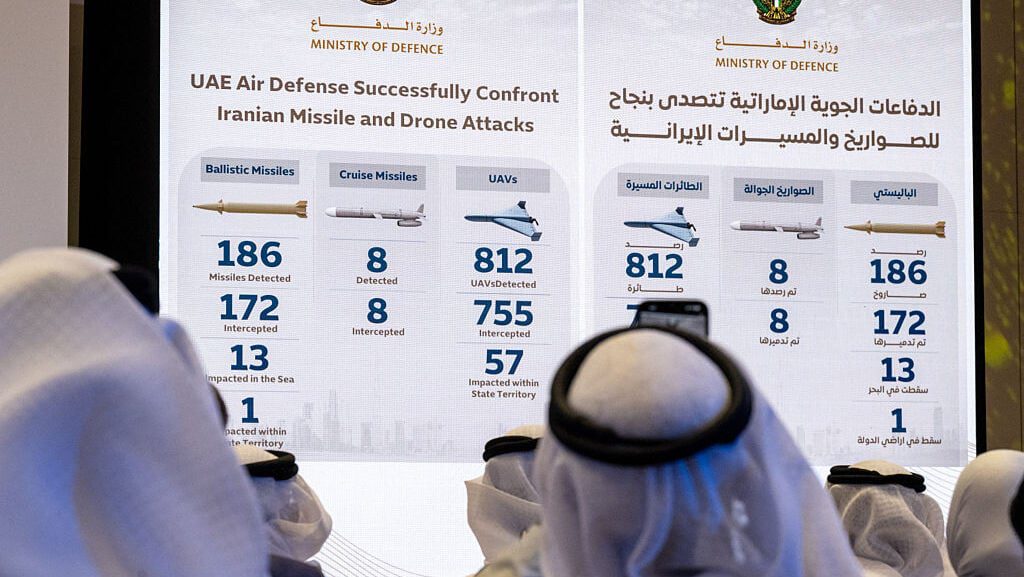
The United Arab Emirates (UAE) is facing a significant challenge in defending its airspace against Iranian attacks. With over 1,514 drones and 283 missiles targeting the UAE, the country’s air defense systems have been put to the test.
Air Defense Capabilities
The UAE operates several air defense systems, including the Terminal High Altitude Air Defense System (THAAD) and Patriot, as well as the South Korean Cheongung-II medium-range KM-SAM. These systems have been effective in intercepting missiles, but drones have proven to be a more difficult target.
According to Jean Loup Samaan, senior research fellow at the Middle East Institute, the UAE’s air defense capabilities are struggling due to depletion. Meanwhile, Brian Carter, research manager at the American Enterprise Institute, suggests that the UAE may have stopped releasing detailed information on intercepted munitions to protect operational security.
Iran’s Strategic Targets
Iran sees the UAE as a strategically aligned Gulf state with Israel, making it a prime target. The UAE’s open and globally connected economy, particularly in Dubai, is also a threat to Iran’s interests. As Marwa Maziad, assistant professor at the Gildenhorn Institute for Israel Studies, notes, the UAE’s normalization and security coordination with Israel create the perception of involvement.
David Des Roches, defense and security expert, attributes the high number of attacks on the UAE to its geography, with Iran’s short-range missiles being able to reach the country. Mohammed Soliman, senior fellow at the Middle East Institute, adds that Dubai’s thriving economy and global connectivity make it a target for Iran.
Challenges in Detecting Drones
Drones have been able to penetrate air defenses more easily than missiles due to their maneuverability and ability to fly at lower altitudes. As Andreas Krieg, senior lecturer at King’s College London, notes, some air defense early warning radars have been targeted by Iran, making it easier for drones to reach their targets.
However, intercepting drones remains a challenge, with most defense systems designed to counter missile and rocket threats. The prioritization of air defenses against ballistic missiles has also led to a rationing of intercepting missiles.
Conclusion and Recommendations
In conclusion, the UAE’s air defense capabilities are facing significant challenges in defending against Iranian attacks. To improve its air defense, the UAE should consider upgrading its systems to better detect and intercept drones. Additionally, the country should prioritize the protection of its air defense early warning radars and ensure that its intercepting missiles are used effectively.
Finally, the UAE should continue to coordinate with its allies, including Israel, to enhance its air defense capabilities and protect its strategic interests. By taking these steps, the UAE can improve its air defense and reduce the risk of successful Iranian attacks.