Unlocking AI Value: Beyond Efficiency and Automation
Most companies measure AI value the wrong way. Instead of asking what new capabilities does this unlock, the conversation quickly turns into questions such as: How many hours can we save? How many people could this replace?
While efficiency is an important source of AI value, it is only part of the picture. Many successful AI systems do not primarily replace human work (and those that do are likely to trigger resistance rather than enthusiasm). Instead, they upgrade existing workflows, amplify human capabilities, or enable entirely new business opportunities.
Three Types of AI Opportunities
This article analyzes value creation across three types of AI opportunities:
- Automation: AI replaces operational tasks previously performed by humans.
- Augmentation: AI supports humans in performing complex tasks and making better decisions.
- Innovation: AI enables new capabilities, products, or operating models.
Value Creation Across AI Opportunities
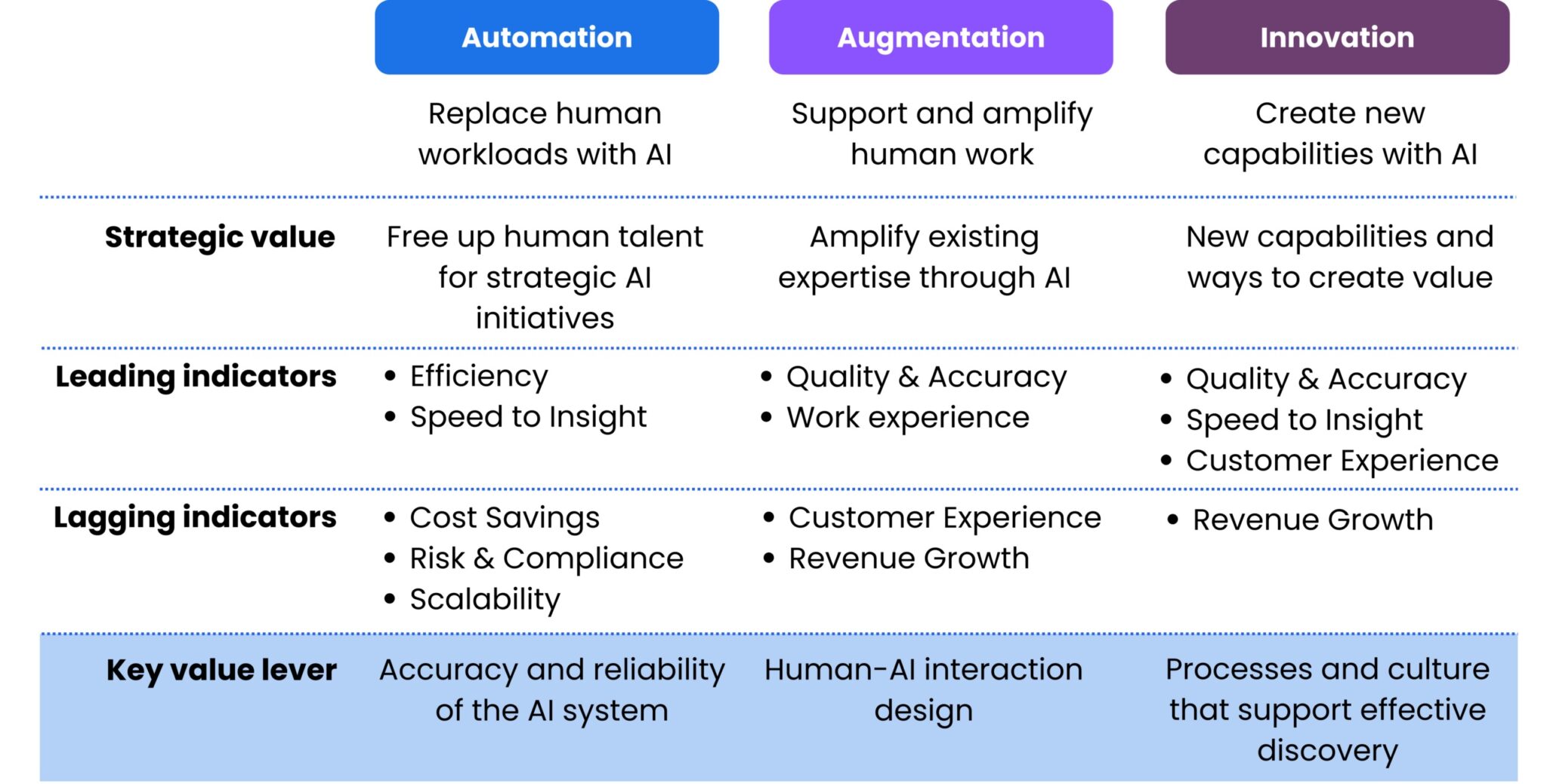
Looking across more than 200 AI use cases collected in our AI Radar, AI value appears across nine performance areas which can be grouped into three categories: process improvements, capability improvements, and financial outcomes (cf. Table 1). Timing matters — AI value rarely appears in a single step but emerges in a chain, starting with process and capability improvements and eventually showing up in financial outcomes.
Automation
In automation, the system takes over an existing task and executes it with minimal human intervention. This is especially useful when large volumes of similar decisions must be made quickly and consistently. The AI system evaluates structured inputs and produces classifications or decisions at scale. Humans might still be involved to compensate for AI inaccuracies through two mechanisms:
- Verification: Humans can approve or reject AI outputs after reviewing them.
- Escalation: AI handles common cases where it has a high confidence, handing off more complex cases to the human.
However, the end game for automation initiatives is to completely remove manual work from a process. The central challenge is therefore reliability: can the system perform the task accurately enough to remove humans from routine execution?
Example: Fraud Detection
Banks process millions of transactions each day. AI systems can analyze these streams in real time and flag suspicious patterns. Most transactions pass automatically, while a small subset is escalated to human analysts for further investigation. The system therefore performs the operational screening, while human experts focus on ambiguous or high-risk cases.
Where Value Emerges
Automation is the most intuitive form of AI value — if a human workload disappears, the impact is easy to quantify and measure.
Leading Indicators
The earliest signal is usually Efficiency. In our example, once the fraud detection system is deployed, most transactions can be screened continuously without manual review. This allows organizations to process large volumes of transactions with far less manual effort.
A second leading indicator is Speed to Insight. Suspicious transactions can be detected immediately rather than after delayed manual analysis, allowing investigators to react faster and reduce potential downstream harm.
Lagging Indicators
Over time, a more efficient process leads in Cost Savings and improvements in Risk & Compliance. Automation also improves Scalability — as the system handles increasing volumes of transactions, organizations can scale operations without expanding investigation teams.
Strategic Value
Automation rarely creates lasting differentiation. Once the technology becomes widely available, competitors quickly catch up. Its real strategic role is foundational: automation removes large amounts of routine work, improves employee experience, and frees up human capacity for more complex, creative, and strategically relevant activities.
Where Value Can Be Amplified
The value of automation systems hinges primarily on the accuracy and reliability of the AI system, which determines how much human intervention is still needed.
Key Levers
The key lever is model accuracy. It determines how well the system distinguishes between legitimate and fraudulent transactions.
A second lever is data coverage and a smooth data pipeline. Fraud patterns evolve constantly, so the system must learn from diverse and up-to-date transaction data, including feedback from human investigators.
Finally, value depends on the accuracy of escalation decisions. The system must determine when to handle a transaction automatically and when to involve a human analyst. Setting this boundary correctly is crucial: too many escalations reduce efficiency, while too few increase risk.
Augmentation
In the augmentation scenario, AI doesn’t fully replace human work but supports human experts in performing their work. Typically, these are complex, multi-step tasks where each step can branch out into different directions depending on the outcome of the previous step.
Example: UX Research
Companies collect large volumes of user feedback across surveys, interviews, product reviews, etc. AI systems can analyze these data sets, identify recurring themes, and generate structured summaries. Product teams can guide the analysis, interpret the insights and translate them into design decisions or roadmap priorities. The AI system expands the information available for decision-making, while humans remain responsible for evaluating and acting on the insights.
Where Value Emerges
Value emerges in better decisions, which eventually compound into better customer experience and financial performance.
Leading Indicators
A common leading indicator is Quality & Accuracy, which can improve for several reasons:
- When AI handles routine tasks such as data processing, experts can dedicate more time to deeper interpretation and judgment.
- Human–AI interaction makes the process more iterative: users can refine questions, explore alternative perspectives, and revisit intermediate results when necessary.
- AI can act as an impartial sparring partner that surfaces patterns or arguments the human expert might overlook, helping to reduce bias and broaden the analytical perspective.
A second indicator is Speed to Insight. As AI takes over time-consuming data processing and analysis tasks, experts can work with larger, more diverse datasets and respond more quickly to changing market conditions.