Introduction to Saturn’s Mysteries
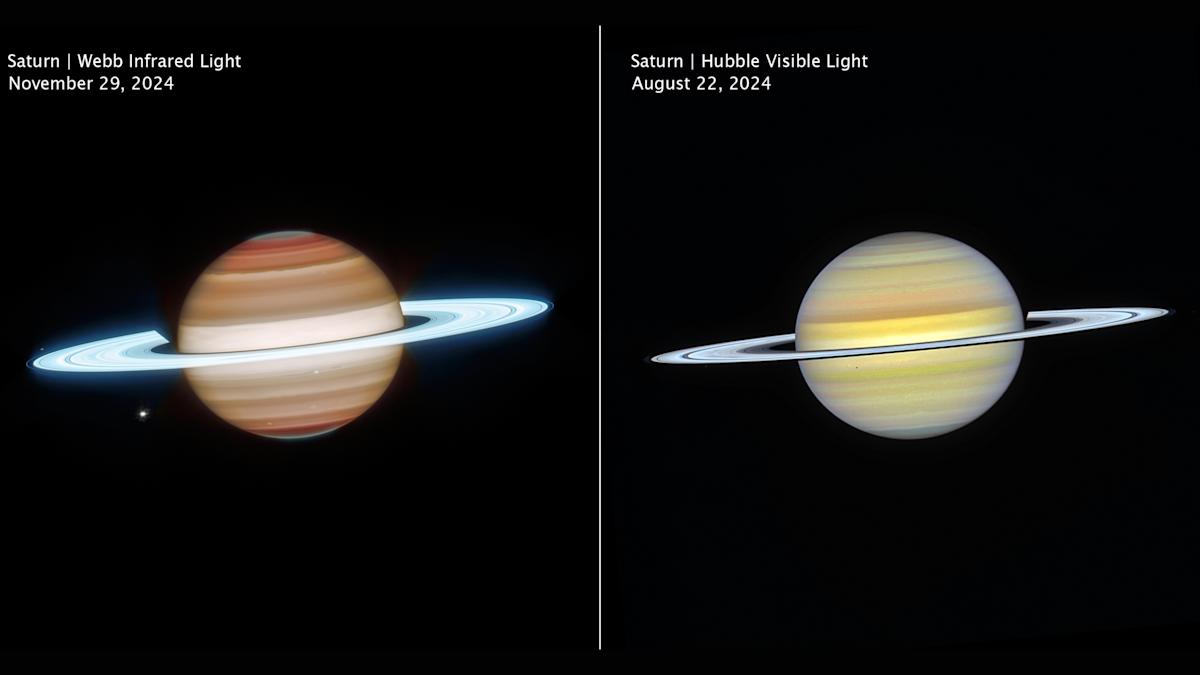
Saturn, the sixth planet from the Sun, has long been a subject of fascination for astronomers and space enthusiasts alike. Recently, the James Webb and Hubble space telescopes have combined forces to offer an unprecedented view of the gas giant’s atmosphere. This collaboration has resulted in a side-by-side comparison of photos captured by both telescopes, highlighting the unique features of Saturn’s outer layers.
Understanding the Telescopes’ Capabilities
The Hubble telescope has historically been used to track storms on Saturn, capturing subtle color variations across the planet. Meanwhile, the Webb telescope’s infrared view senses clouds and chemicals at many different depths in the atmosphere, from the deep clouds to the tenuous upper atmosphere. This difference in capabilities allows scientists to peek at several layers of the planet’s atmosphere, gaining valuable insights into its composition and movement.
For example, the Hubble images captured in August 2024 as part of the Outer Planet Atmosphere Legacy program reveal bands of atmospheric clouds. In contrast, the Webb images shot a few months later highlight even more detail, including the highly-reflective ice of Saturn’s ring and grey-green shading on the planet’s poles.
Uncovering the Secrets of Saturn’s Atmosphere
The different coloring in the Webb photo could be caused by a layer of high-altitude aerosols scattering light across latitudes or charged molecules interacting with the planet’s magnetic field, causing auroral activity. These findings are valuable to scientists, who can use this information to better understand the dynamics of Saturn’s atmosphere.
Additionally, the visual information from both telescopes will prove to be more valuable over time. The 2024 observations, taken 14 weeks apart, show the planet moving from northern summer toward the 2025 equinox. As Saturn transitions into southern spring, and later southern summer in the 2030s, Hubble and Webb will have progressively better views of that hemisphere.
The Power of Collaboration
The collaboration between the Webb and Hubble telescopes demonstrates the power of combining different sensors and capabilities to gain a deeper understanding of our universe. By working together, scientists can uncover new insights and make new discoveries that would be impossible with a single telescope.
Furthermore, this collaboration highlights the importance of continued investment in space exploration and the development of new technologies. As we continue to push the boundaries of what is possible, we may uncover even more secrets of the universe, leading to a greater understanding of our place within it.
Practical Applications and Future Directions
The findings from this collaboration have significant implications for our understanding of planetary atmospheres and the potential for life beyond Earth. By studying the composition and movement of Saturn’s atmosphere, scientists can gain insights into the conditions necessary for life to exist on other planets.
Moreover, the development of new technologies and sensors will enable us to study the universe in greater detail, leading to new discoveries and a deeper understanding of the cosmos. As we continue to explore and learn, we may uncover new and exciting possibilities for human spaceflight and the search for life beyond our planet.
Conclusion and Call to Action
In conclusion, the joint effort by the Webb and Hubble telescopes has unlocked new secrets of Saturn’s atmosphere, offering a unique view of the gas giant’s outer layers. As we continue to explore and learn, we must remember the importance of collaboration and the development of new technologies. By working together and pushing the boundaries of what is possible, we can uncover new insights and make new discoveries that will shape our understanding of the universe for generations to come.
Therefore, we must continue to invest in space exploration and the development of new technologies, ensuring that we have the tools and capabilities necessary to unlock the secrets of the universe. Additionally, we must support the scientists and researchers who are working tirelessly to advance our understanding of the cosmos. By doing so, we can ensure a bright future for space exploration and the search for life beyond our planet.
Finally, as we look to the future, we must remember the power of collaboration and the importance of working together to achieve great things. By combining our knowledge, skills, and capabilities, we can overcome even the most significant challenges and achieve greatness. So, let us continue to explore, learn, and push the boundaries of what is possible, and let us do so together.