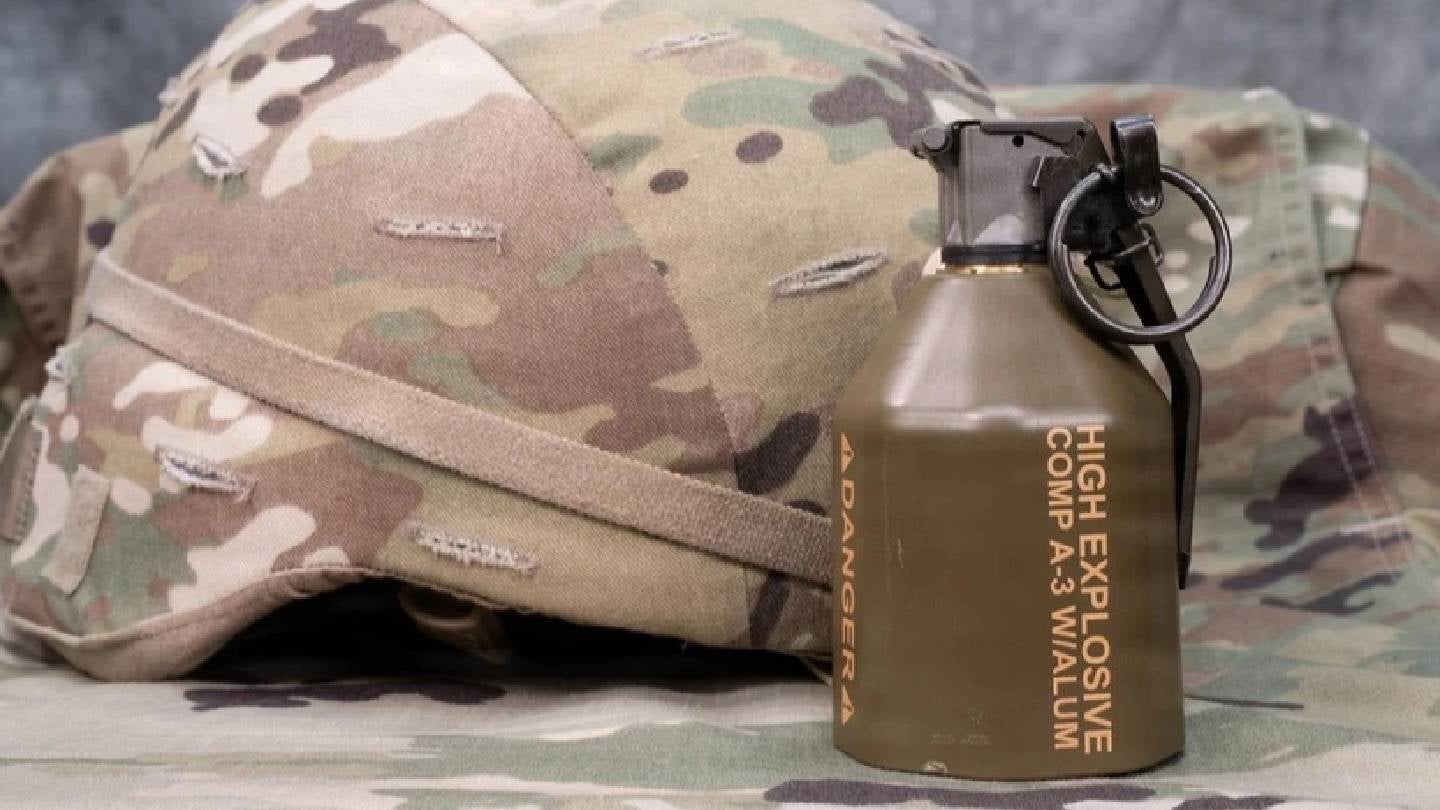
The US Army has granted full material release for the M111 Offensive Hand Grenade (OHG), marking the first time since 1968 that a new lethal hand grenade has reached this stage.
Replacing the Mk3A2 Series
The new OHG will replace the Mk3A2 series, which is now restricted due to its asbestos body.
Developed by the Capabilities Program Executive Ammunition and Energetics (CPE A&E) alongside the US Army Combat Capabilities Development Command (DEVCOM) Armaments Center at Picatinny Arsenal, the M111 features a plastic casing that is 100% consumed during detonation.
Blast Overpressure: A Game-Changer in Urban Warfare
The M111 employs blast overpressure (BOP) as its main mechanism rather than fragmentation, aiming to provide increased operational safety and enhance combat readiness.
According to the US Army, BOP effects can deliver significant impact to enemy personnel and equipment in confined spaces without producing fragmentation, reducing risks in close-quarter urban environments.
In open terrain, soldiers will continue to use the M67 fragmentation grenade to maximise lethal fragment effects, while in enclosed or restricted areas such as buildings or structures, the M111 will be deployed to leverage its blast overpressure capabilities.
Standardizing the Arming Process
The M111 grenade and its training version, the M112, use the same five-step arming process as the M67 and M69 models, which allows soldiers to train with procedures that mirror those used in combat.
Both the M111 and M112 also share fuzes with their respective predecessors, enabling the Army to reduce costs through shared production lines and greater economies of scale.
Additionally, government-owned intellectual property for both grenades allows the Army to open production contracts to competition across the industrial base, increasing opportunities for multiple suppliers.
Colonel Vince Morris, CPE A&E close combat systems project manager, stated: “By standardising the arming process and the fuzing, the Army saves taxpayer money without sacrificing lethality on the battlefield. This is the kind of acquisition reform that is currently underway throughout the Army acquisition enterprise. We are taking advantage of that initiative to drive down costs while increasing combat effectiveness.”
The M111 hand grenade is a significant step forward in urban warfare, providing a safer and more effective option for soldiers operating in close-quarter environments.
As the US Army continues to modernize its arsenal, the M111 hand grenade is a prime example of innovation and acquisition reform in action.
With its blast overpressure mechanism and standardized arming process, the M111 is poised to revolutionize urban warfare and provide a safer and more effective option for soldiers on the battlefield.
The full material release of the M111 hand grenade marks a significant milestone in the development of new lethal hand grenades, and it will be interesting to see how it is deployed in the field.
The US Army’s commitment to innovation and acquisition reform is evident in the development of the M111 hand grenade, and it will be exciting to see how this technology continues to evolve in the future.