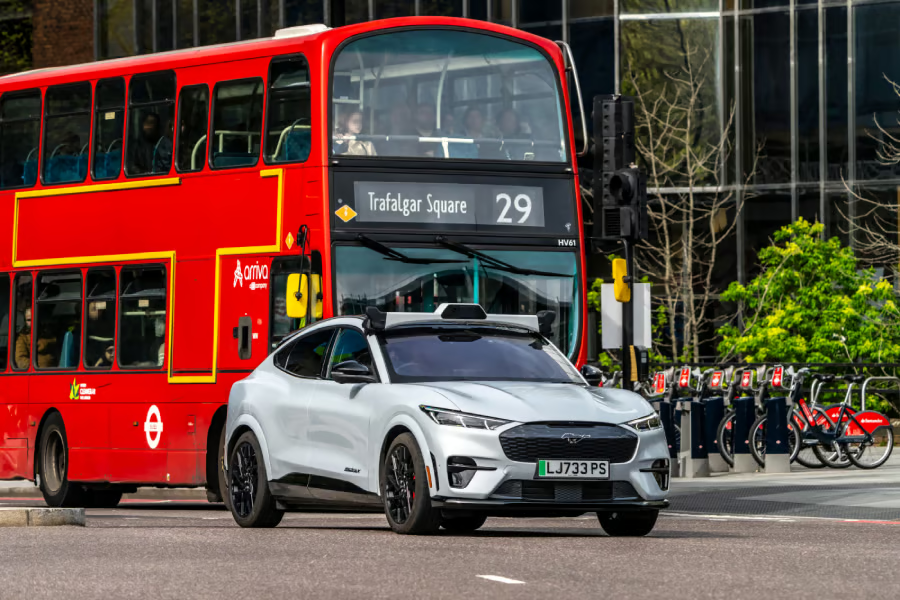
Wayve: UK Self-Driving Startup Reaches $8.6B Valuation
Imagine a future where autonomous vehicles glide through city streets without human intervention. That vision is closer to reality thanks to Wayve, a UK-based self-driving startup that recently hit an $8.6 billion valuation. This milestone cements its position as one of the most valuable tech companies in the UK—and a key player in the race to launch the first commercial robotaxi services.
How a UK Self-Driving Startup Became a Billion-Dollar Powerhouse
Wayve’s meteoric rise began with a $1.2 billion funding round led by major automotive giants like Mercedes-Benz, Stellantis, and Nissan. This injection of capital not only boosted its valuation but also signaled industry confidence in its AI-driven autonomous driving technology. The startup already has a commercial partnership with Nissan, while Mercedes and Stellantis are exploring how to integrate Wayve’s systems into their vehicles.
What sets Wayve apart? Unlike traditional self-driving companies that rely on pre-mapped environments, Wayve uses machine learning to adapt in real time. This “learning while driving” approach allows its vehicles to handle unpredictable urban scenarios more effectively—a critical advantage for real-world deployment.
Robotaxi Ambitions: Wayve’s UK Pilot Plans
With its valuation now surpassing $8.6 billion, Wayve is positioning itself to lead the UK’s upcoming robotaxi pilot program. The government’s ambitious plan to test autonomous vehicles on public roads aligns perfectly with Wayve’s roadmap. The startup aims to launch a commercial robotaxi service in the UK within the next 18–24 months, leveraging its partnerships with automakers to scale rapidly.
Key Partnerships Driving Innovation
- Nissan: Already collaborating on autonomous vehicle integration
- Mercedes-Benz: Exploring fleet electrification and self-driving tech
- Stellantis: Testing AI-powered navigation systems
Why This Matters for the Future of Mobility
The self-driving industry is at a crossroads. While companies like Tesla and Waymo dominate headlines, Wayve’s UK-based approach offers a fresh perspective. By focusing on machine learning and real-time adaptation, it’s tackling one of the biggest challenges in autonomous tech: handling complex urban environments without extensive pre-mapping.
For consumers, this means safer, more reliable self-driving services. For businesses, it opens new revenue streams through autonomous ride-hailing and logistics. And for the UK, it positions the country as a global leader in AI-driven mobility solutions.
What’s Next for Wayve?
Wayve’s next steps include:
- Finalizing technical integration with partner automakers
- Securing regulatory approvals for its robotaxi pilot
- Expanding its AI training datasets to cover global road conditions
If successful, Wayve could become the first European company to launch a commercially viable robotaxi network. This would not only validate its technology but also create thousands of jobs in AI research, vehicle engineering, and mobility services.
Conclusion: The Road Ahead for Autonomous Tech
Wayve’s $8.6 billion valuation is more than just a financial milestone—it’s a sign that the self-driving industry is maturing. As the UK prepares for its robotaxi pilot, Wayve’s success could reshape urban transportation, reduce traffic fatalities, and create new economic opportunities.
Stay tuned: Follow Wayve’s progress and explore how autonomous vehicles might transform your city. Want to dive deeper? Check out our guide to robotaxi technology and AI in transportation.